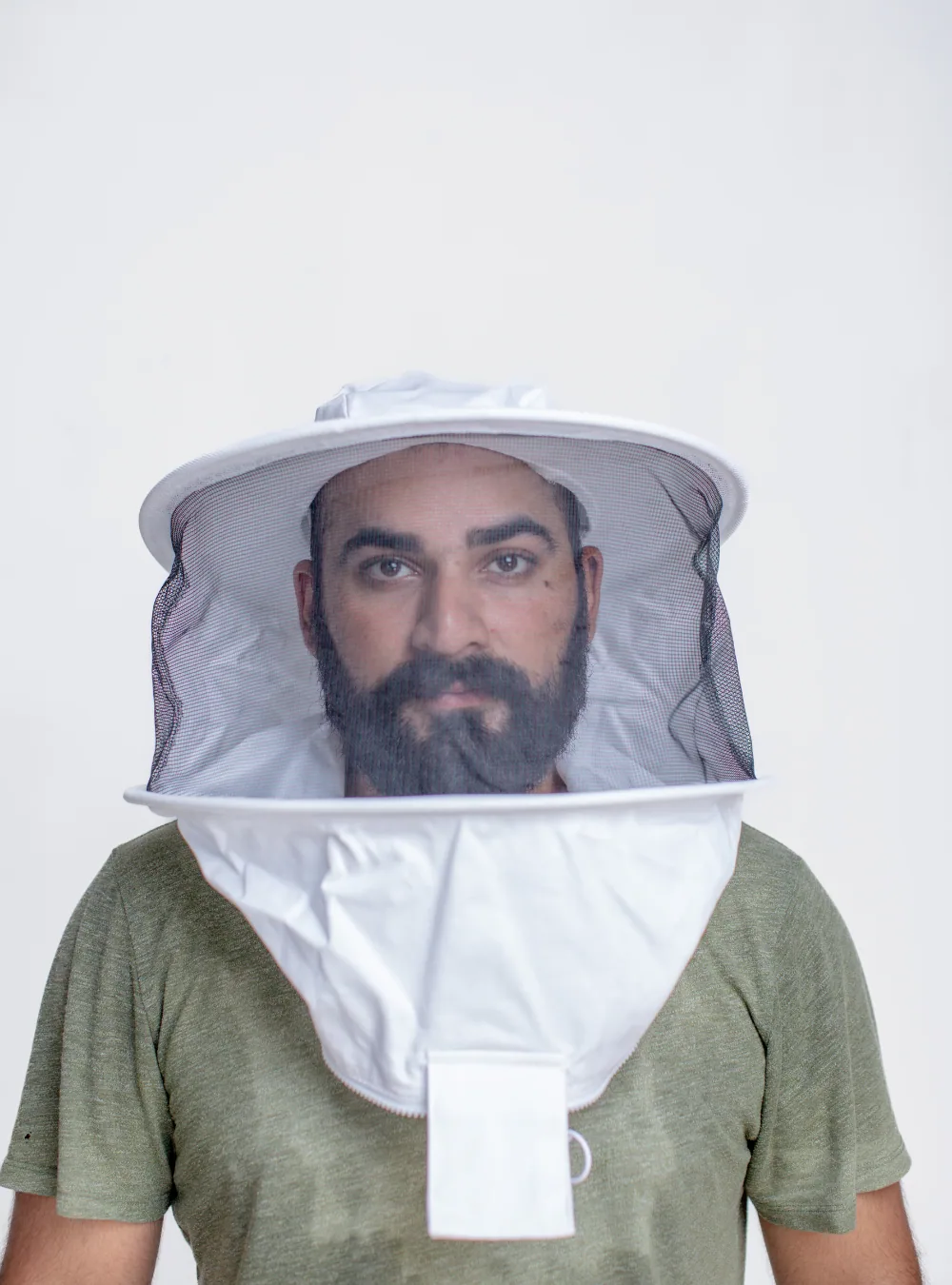
Wearing a bee veil with a beard
A beard pushes mesh away from the chin and onto the cheeks, and a sting goes straight through mesh touching skin. Veil shape fixes it; trimming does not.

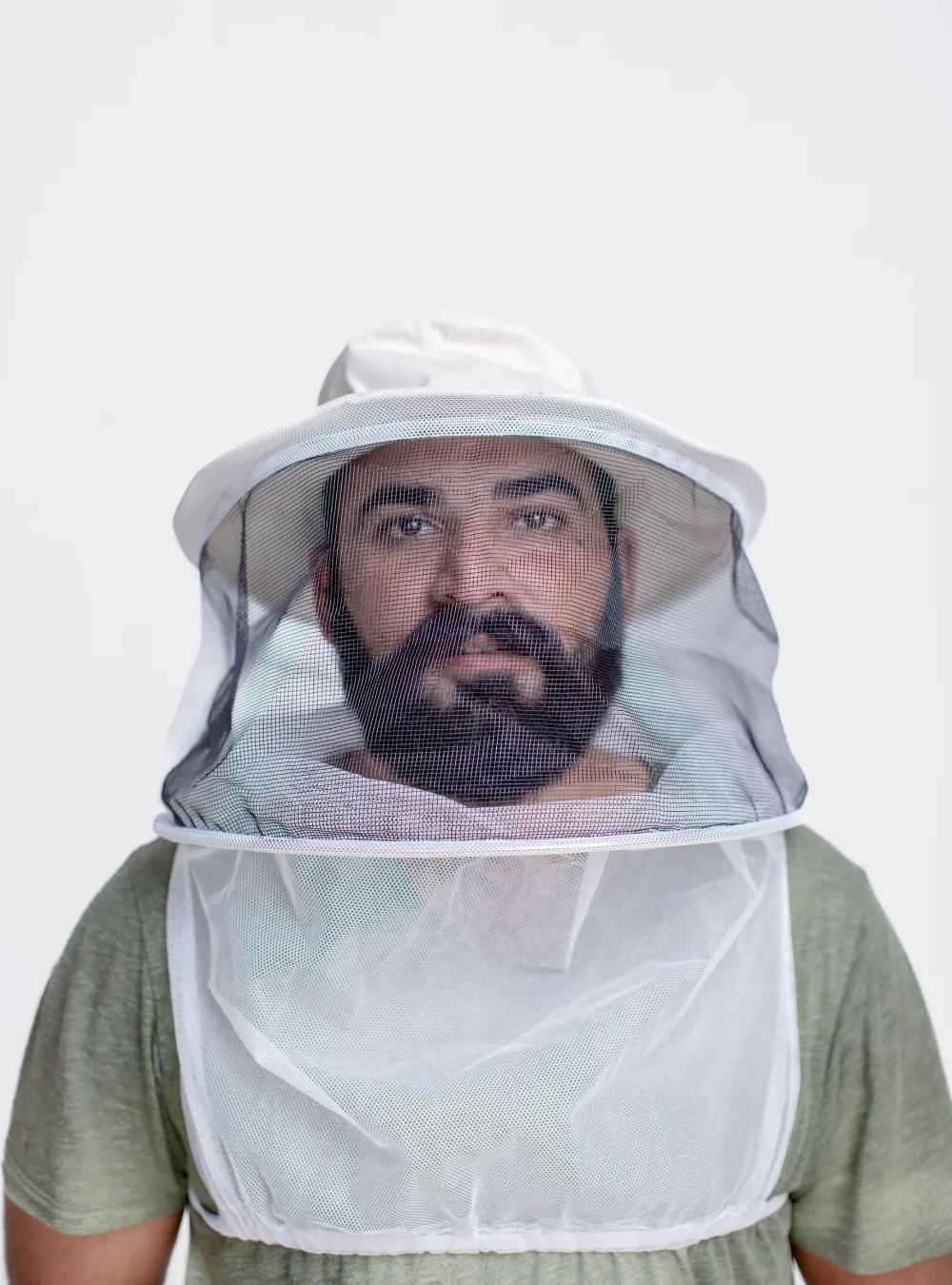
A bee veil with a beard is a fit problem, not a hygiene one. A beard takes up the space between your chin and the mesh, pushes the panel outward at the bottom and tips it inward at the top, so the mesh ends up resting on your cheekbones. Mesh touching skin is mesh a sting goes straight through.
The answer is the veil's shape, and it is not trimming your beard.
Why a beard changes the geometry
Every veil is held away from your face by something: a collar, a frame, a hat brim. The clearance is designed around an average face, and a beard is simply more face than that average.
What happens next is predictable, and it is the whole of why a bee veil with a beard sits wrong. The chin pushes the bottom of the panel out, the veil pivots, and the top comes in. So the point of contact ends up high - cheekbones, temples, the bridge of the nose - which is exactly where a sting is least welcome.
It is the same mechanism as wearing a veil over glasses: something occupying the clearance, and the veil rotating around it.
Choosing a bee veil with a beard
Ranked by how much clearance they hold independently of your face.
| Veil | With a beard |
|---|---|
| Square or English veil on a frame | Best. The frame sets the distance and a beard cannot move it |
| Round veil over a wide-brimmed hat | Very good. The brim holds the panel out all round |
| Fencing veil with a stiffened collar | Good, if the collar is genuinely stiff. A soft one collapses onto the chin |
| Fencing veil, soft collar | Poor. This is where most complaints come from |
| Hood with a drawstring | Worst. The drawstring pulls the mesh directly onto the beard |
The pattern is the same one that decides whether a veil fogs: a panel held out by structure behaves; a panel held out by nothing does not. Round against square and the fencing veil's pros and cons cover the rest of each style.
Things that do not fix it
- Trimming. Unless you shave entirely, the clearance problem stays. Half a beard is still a beard to a veil, so a bee veil with a beard needs a different veil rather than a shorter beard.
- A bigger veil. Loose mesh moves more, so a baggy veil touches your face in more positions, not fewer.
- Tightening the drawstring. This is the instinct and it is backwards: it pulls the panel in.
- Tucking the beard into the collar. Uncomfortable, and it leaves a gap at the neck where the hair bunches.
The dark hair problem on top of it
Worth naming, because it compounds. A dark beard is dark and fuzzy, which is the combination colonies are built to react to. It sits at head height, where a defensive bee investigates first.
The veil solves this entirely while it is on, which is one more reason the fit has to be right. Why bees react to dark colours explains the behaviour behind it.
Checking a bee veil with a beard yourself
Put the veil on indoors and do four things. Look straight ahead, look down at your hands, turn your head fully each way, then lean forward as if over a brood box.
At every point the mesh should clear your beard and your cheeks. If it touches at any of them, that is where you will be stung - so change the veil rather than deciding to be careful. Looking down at frames is the position that catches most veils out.
If you are already stung through the veil
Then the diagnosis is confirmed: that veil is wrong for you. A sting through mesh is not bad luck. It means the mesh touched you.
Replacing a bee veil with a beard in mind costs far less than replacing the suit, and many suits take a different veil style - replacing a bee suit veil covers what attaches to what.
The short version
A bee veil with a beard needs its clearance set by structure, not by your face: a framed square veil, a round veil over a brimmed hat, or a fencing veil with a genuinely stiff collar. Check it by moving before you go near a colony, and replace rather than trim.
The hat and veil range has all three styles, and the round veil over a brim is the most forgiving of a big beard. The University of Georgia bee programme and Penn State Extension publish more on working safely around colonies.