
Bees and dark colours: why they react
Bees react to dark colours because dark, fuzzy shapes are what their predators look like. They read contrast and texture, not the name of a colour - which is why any pale shade is fine and black is not.

Bees and dark colours do not mix. The reason is older than beekeeping: the animals that raid a wild nest are dark and furry. Bears, badgers, skunks, honey badgers. A colony that reacted hard to dark, fuzzy shapes survived more raids. That is the colony we inherited.
So the thing a bee is reading is not the name of a colour. It is contrast against the sky, and the texture of the surface.
Why bees and dark colours are an old problem
Nothing about this is a modern quirk. It is a defence that evolved against mammals, and we happen to be mammals. Stand over an open hive in a black fleece and you are wearing the outline of a bear.
Which is also why the fix is so cheap. You are not managing a preference. You are staying outside a shape the colony is built to recognise.
What a honey bee actually sees
Bee colour vision is not ours shifted sideways. It is a different set of receptors. Bees see ultraviolet, blue and green. They have no red receptor at all.
So red reads to a bee much the way black reads to us. Not as a colour, but as an absence of light. People get this backwards. A red bee suit is not a cheerful alternative to white - to the colony it is among the darkest things you could have put on.
The useful half is the flip side, and it is the practical content of everything said about bees and dark colours. A pale surface reflects a lot across the range a bee can see, whatever its hue to us. Pale pink, cream, pale yellow and khaki all land in the same place. Bright, low contrast, uninteresting.
What colours do bees dislike?
Ranked by how reliably beekeepers see a reaction, rather than by how dramatic it sounds.
| Colour | How it reads to a colony | Wear it at a hive? |
|---|---|---|
| Black | The darkest contrast there is, and the colour of every mammal that robs a nest | No |
| Dark brown, charcoal | Nearly as dark, and usually on fuzzy outdoor fabric. That makes it worse | No |
| Navy, dark green | Read as dark, not as a colour. No receptor tells them apart from black | No |
| Red, burgundy | Dark, because there is no red receptor to see it with | No |
| Mid grey, mid blue | Neither one thing nor the other. Tolerated, but a compromise for no gain | If you must |
| White, cream, khaki, pale pink, pale yellow | Bright and low contrast. Nothing a colony responds to | Yes |
Nothing in that table is about hue. Shift any of the bottom row dark and it moves to the top row. That is the whole of bees and dark colours, in one sentence. It is why coloured bee suits work at all, and why pink and pastel suits are a real option rather than a novelty.
Texture does as much work as colour
Two garments in the same dark grey do not get the same reception. A smooth dark shell is less provocative than a fuzzy dark fleece. The fleece has a second problem too.
A bee that lands on a fuzzy surface cannot walk off it cleanly. It becomes trapped. A trapped bee stings.
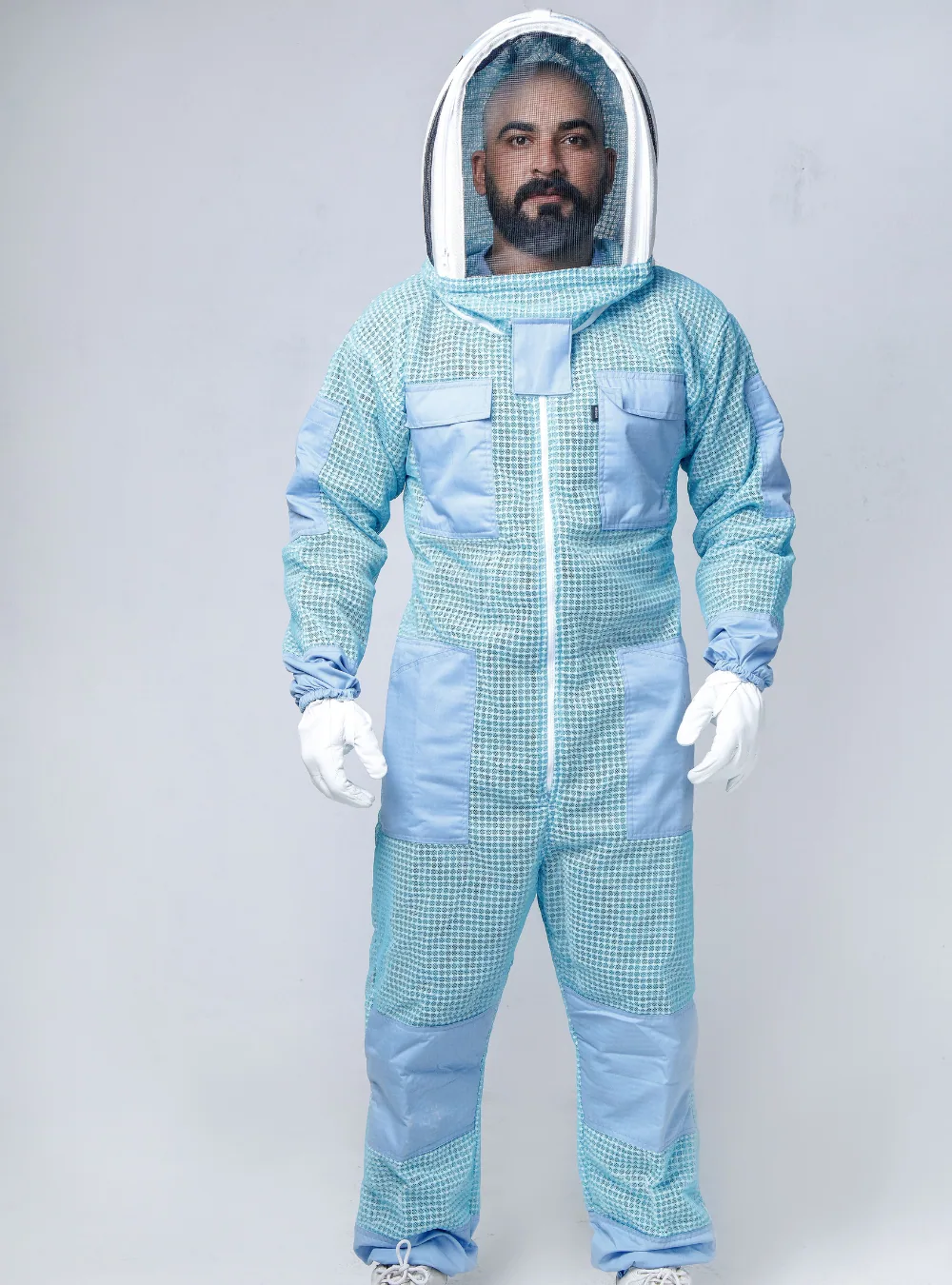
So bees and dark colours is really a rule about two things at once, and this is the half that gets dropped. "No dark clothing" is one part of it. The other part is no wool, no fleece, no brushed cotton, no mohair - at any colour. Smooth and pale is the pairing that works. It is why suit fabric is a tight plain weave or a layered mesh rather than anything soft.
Can you wear black around bees?
Not if you can avoid it, and almost always you can. This is the easiest mistake to stop making. The fix costs nothing: leave the black fleece in the car.
Two things catch people out even when the suit itself is right.
- Hair. Dark hair is dark and fuzzy, which is exactly the combination. It also sits at the top of your silhouette, where a defensive bee looks first.
- Boots and gloves. A pale suit over black wellingtons leaves a dark band at the ankle. That is the height bees patrol, and ankles already take a disproportionate share of stings.
Bees and dark colours below the knee
Worth its own heading, because it is the gap in most people's kit. The suit is pale, the veil is right, and the feet are black rubber.
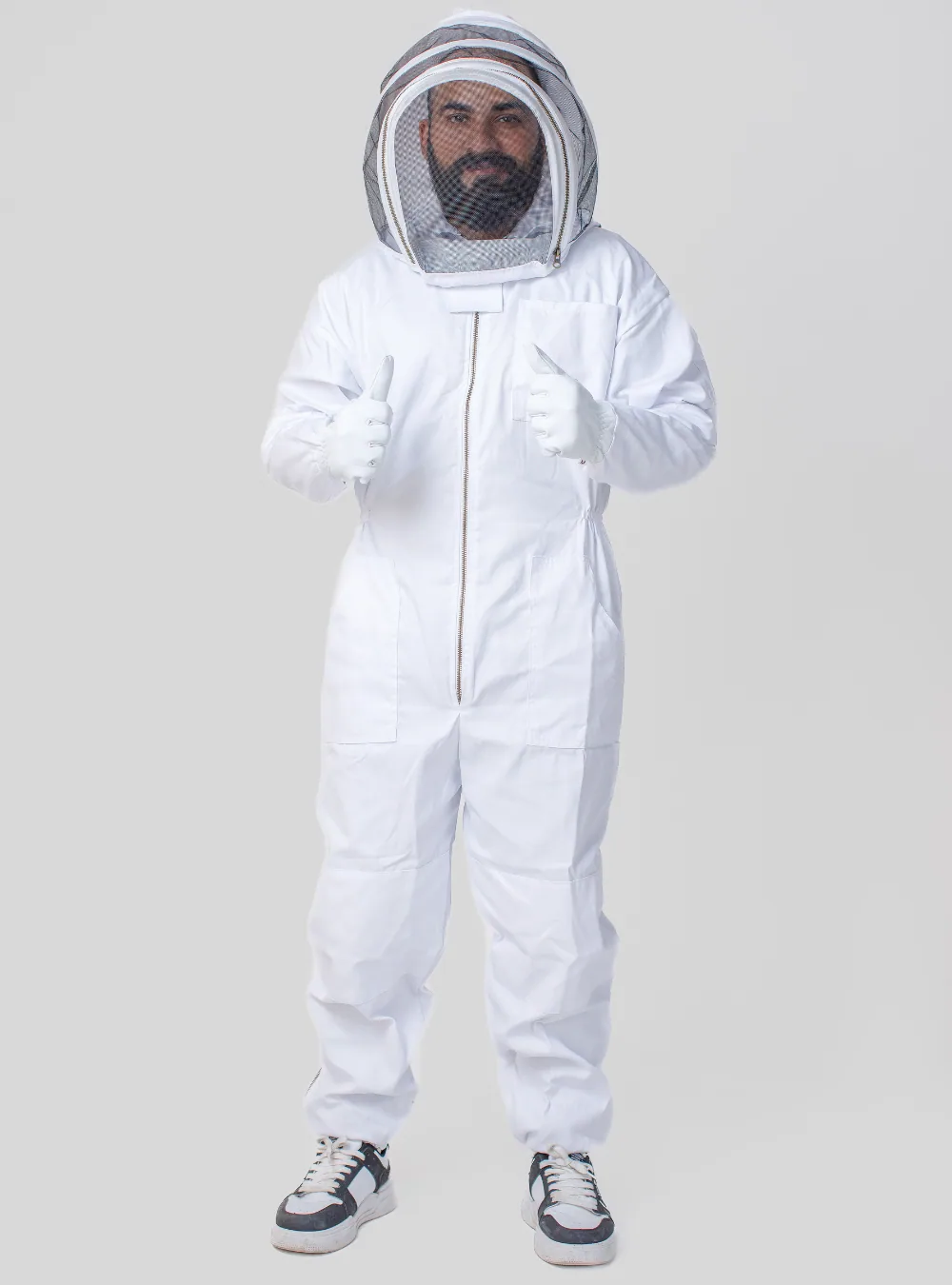
Pale boots are hard to buy, so the practical answer is a suit with ankles long enough to sit over the boot rather than inside it. Sealing wrists and ankles covers how to get that overlap right. A white fencing suit with elasticated ankles does it without any effort from you.
The one place dark is correct
The veil mesh, and only its front panel. Dark mesh absorbs the light coming at your face rather than scattering it. You look through the weave instead of at it.
Pale mesh in bright sun becomes a glowing screen a few centimetres from your eye. That is not a contradiction of anything above. The dark panel is small, held off your skin, and sits inside the outline of a pale garment. The reason veil mesh is black is visibility, not camouflage.
Bees and dark colours: the three rules
- Pale and smooth from head to ankle, including whatever goes on your feet.
- Cover dark hair with the veil before you open anything.
- Stop weighing up which pale shade. It genuinely does not matter, and white is a convention rather than a requirement.
If you want a suit that satisfies all three without thought, the plain cotton suits and the ventilated range are both pale, smooth and sealed at the openings. For further reading on honey bee biology, the University of Georgia bee programme and Penn State Extension are written for beekeepers rather than for search engines.
And if this is your first suit, whether you need a full suit at all is worth settling before the colour of it. Bees and dark colours is a question you can answer once and then stop thinking about.