
Second hand bee suit: what to check
A used suit can be a good buy. Four checks separate one that has years left from one that looks fine and protects nobody.

A second hand bee suit is often a sensible buy, especially for a child or a first season. Four checks tell you whether it still works: stretch the cuffs, hold the mesh to the light, run every zip, and try it on. Staining does not matter and tired elastic does — which is the opposite of what most people look at.
The four checks on a second hand bee suit
Elastic is what fails first on any suit, so start there.
1. Stretch each cuff and ankle, then let go. It should snap back and grip. Elastic that stays stretched is the commonest fault on a used suit and the most consequential, because the cuffs are what close the garment. A suit with slack cuffs is an open sleeve whatever else is right about it.
This is repairable — new elastic is a job for anyone who alters clothes — so it is a bargaining point rather than a deal-breaker. But it has to be priced in.
2. Hold the veil mesh up to the light. Look for snags, thinning and pinholes, especially at the crown and where the mesh meets the collar. A centimetre of damage becomes a hole in a season.
Then check the stand: a fencing veil should hold its shape away from your face on its own. One that has been stuffed in a bag for two years and lost its stiffening is a veil resting on your nose, and that cannot be fixed.
3. Run every zip, end to end, twice. Especially the hood zip, which goes round a curve and is opened and closed every visit. A zip that catches will fail, and on a veil it fails at the worst moment.
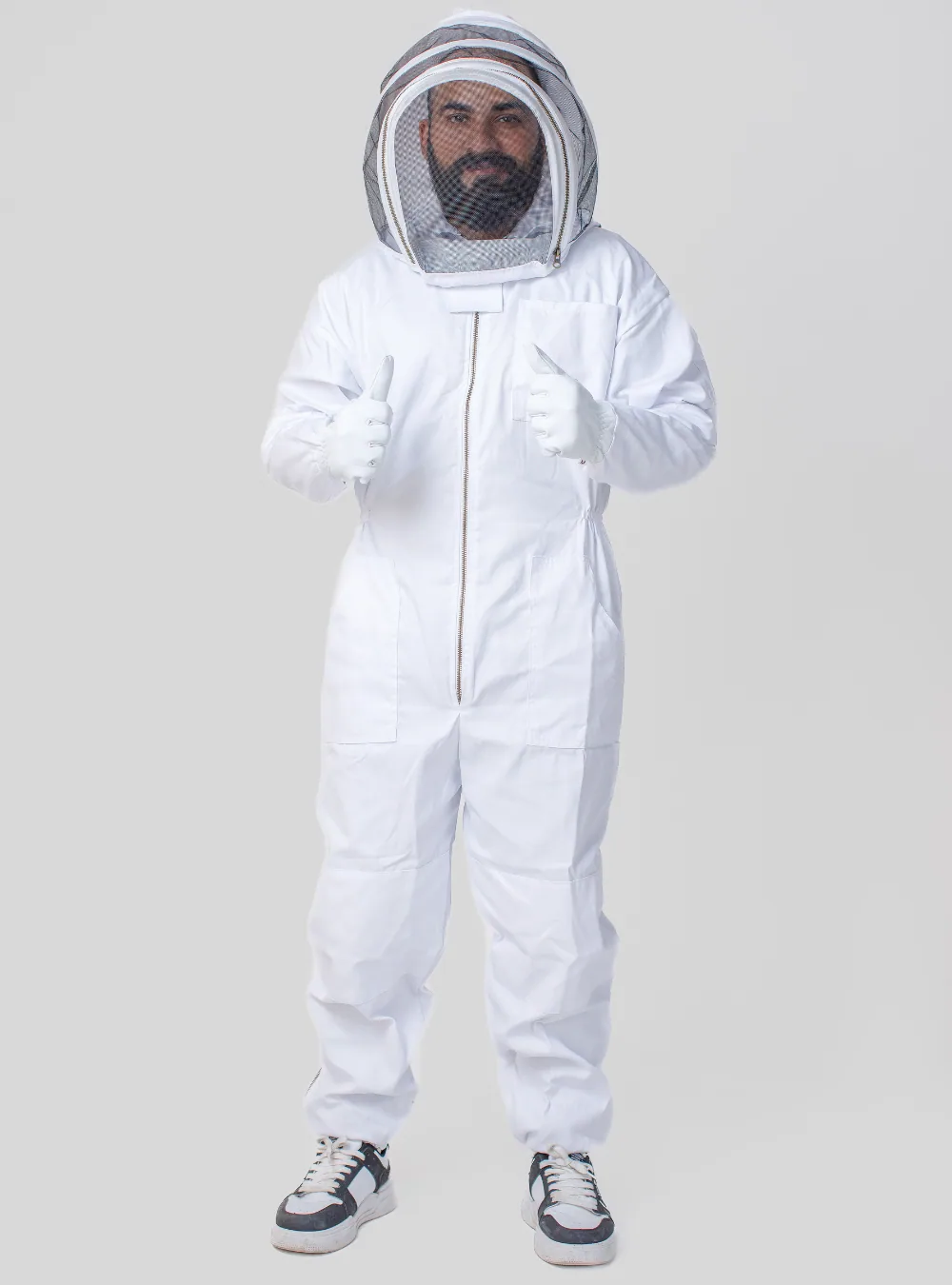
4. Put it on and move in it. Reach forward as if lifting a frame, crouch all the way down, then look at your own boots. Cuffs should stay over your gloves, ankles over your boots, and the mesh should keep a visible gap from your face. How a bee suit should fit is the full version of that test.
What does not matter on a second hand bee suit
| What you will see | Does it matter? |
|---|---|
| Propolis staining | No. Permanent, cosmetic, and every used suit has it. |
| Wax marks | No. Mostly scrapes and washes off. |
| Faded colour | Only as a clue — see below. |
| Smoke smell | No. Airing and a cool wash handle it. |
| Worn knees | Minor. Patchable until they go through. |
If you are buying privately and want a second opinion on condition, a local association will usually look at a suit with you — Penn State Extension’s beekeeping resources and Cornell’s Pollinator Network are good places to find one near you. Fading is worth a second look, though, because it is evidence. A suit noticeably bleached on one side has been stored in sunlight, and ultraviolet degrades elastic and mesh at the same time as it takes the colour out. Fading is the visible part of damage you cannot see.
The one fault that ends a second hand bee suit
Mesh that has gone soft and flat. On a ventilated suit the protection is the gap the bonded layers hold open, and once that structure has collapsed — from heat, from a tumble dryer, from years of compression — nothing restores it.
Press the fabric between finger and thumb. It should feel springy and resist. If it squashes flat and stays there, the suit looks like a bee suit and is not one. Three-layer versus two-layer mesh explains what you are feeling for.
Where second hand bee suits come from
Three sources, in roughly descending order of how much you can trust what you are told.
A local association. Members sell on, and someone there knows the suit and the person. You can usually try it on, and advice comes free. This is the best route and the one most beginners do not know about.
A beekeeper selling up. Often barely used kit, because the suits that come to market are frequently from people who tried a season and stopped. Ask how many seasons it actually saw.
A general auction or marketplace listing. Cheapest and riskiest. Photographs hide everything that matters here — mesh condition, elastic, the stand in a veil — so assume you are buying a suit that needs a new veil until you can prove otherwise.
Questions worth asking the seller
- How was it stored? "Hanging in the garage" and "in a wardrobe" are different suits. A shed means damp; a window means ultraviolet.
- Has it been tumble dried? A yes explains slack cuffs and flat mesh before you have found them.
- Why are you selling it? "Bought the wrong size" is the answer you want. "Gave up beekeeping" usually means it has had little use.
- Can I see the veil separately? Photographs flatter mesh. If you cannot inspect it, assume it needs replacing.
A second hand bee suit for a child
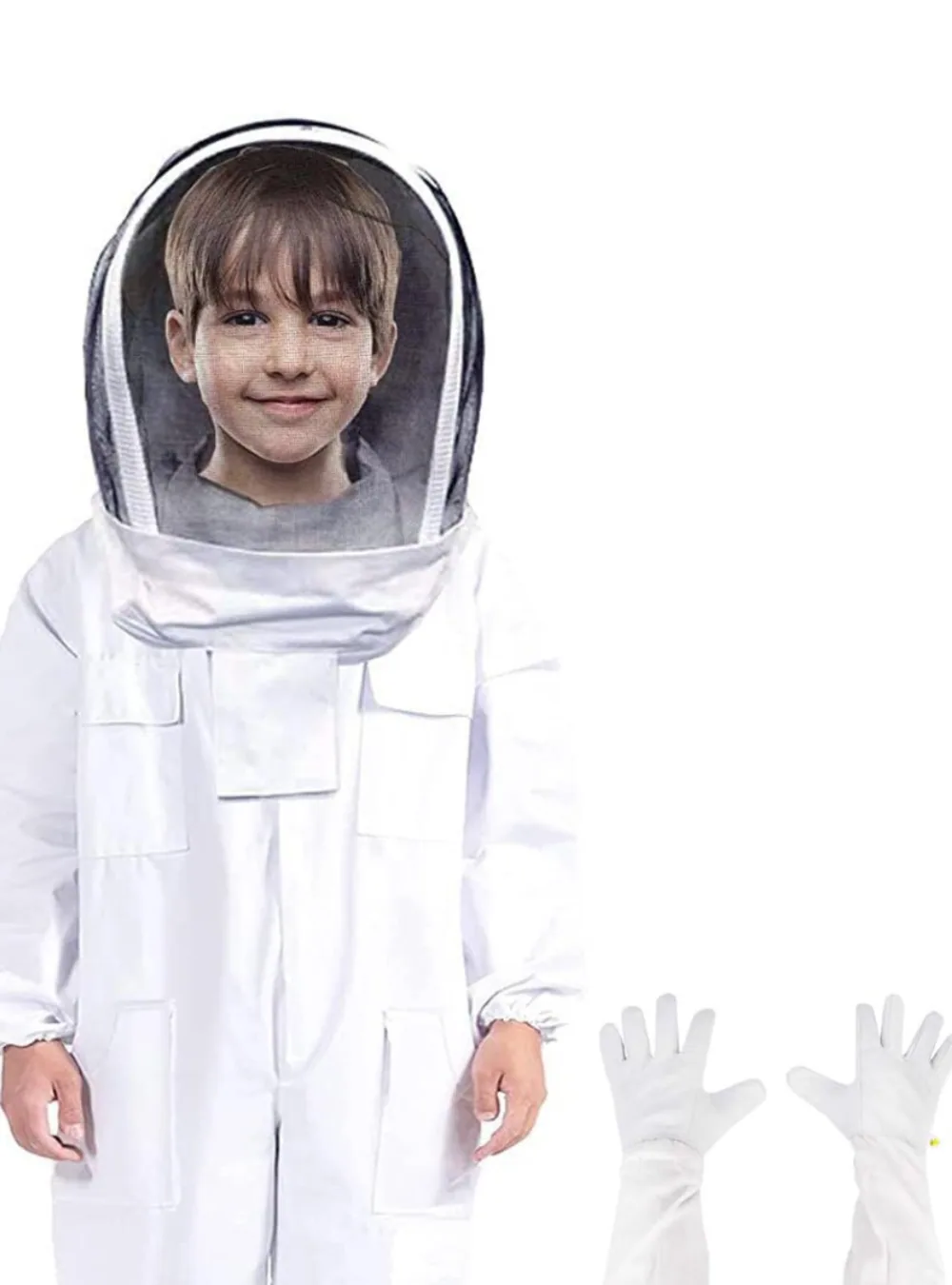
A first season is the other case — a beginner does not yet know what to specify. But children are where it makes most sense, because they outgrow suits long before they wear them out, so used children's suits are often barely used.
Apply the same four checks, and one more: the suit must close properly on the child today. The temptation to buy big because it was cheap is the same mistake as buying big new, and the openings are where it bites. The children's buying guide covers why a child's suit is cut as its own garment rather than graded down.
Selling your own
The same list, from the other side. A suit sells faster and more honestly if you wash it first, photograph the veil mesh against the light, say plainly how it was stored, and give the chest measurement rather than only the size label — labels vary between makers and a measurement does not.
And say if the elastic has gone. It is the first thing a careful buyer checks, and the sale that falls apart on the doorstep costs you more than the honest listing would have.
What you give up with a second hand bee suit
Three things, and they are worth knowing rather than discovering.
There is no fit guarantee and usually no return. You are buying it as seen, which is why trying it on matters more than it would in a shop.
You will not know whether replacement veils and cuffs can still be bought for that model. That question decides whether a used suit is a bargain or a one-season purchase — see what to check in a warranty, which is largely a list of parts questions.
And a suit cut to someone else's measurements will not fit you properly. If the chart has never fitted you, a used suit will not either, and a measured one is the answer rather than a cheaper mistake.
Before the first wear
Wash it. Not for cleanliness — for pheromone. A second hand bee suit carries whoever wore it last. A suit that has been stung in carries alarm scent, and introducing that to your own colony is a bad first impression. Wash it cool, veil out, line dry in the shade.
If the checks go badly, the parts are often cheaper than the suit: veils and hats and gloves are the two most likely to need replacing.