
How to repair a torn bee suit
Most tears are worth mending and a few are not. The dividing line is whether the repair restores the gap that stops a sting.

To repair a torn bee suit, work out first what the tear has cost you. A hole in the outer fabric is a hole, and patching it restores the suit. A crushed or delaminated ventilated panel has lost the gap that stops a sting, and no patch brings that back. Mend the first kind the week you find it; replace the second.
The test before you repair a torn bee suit
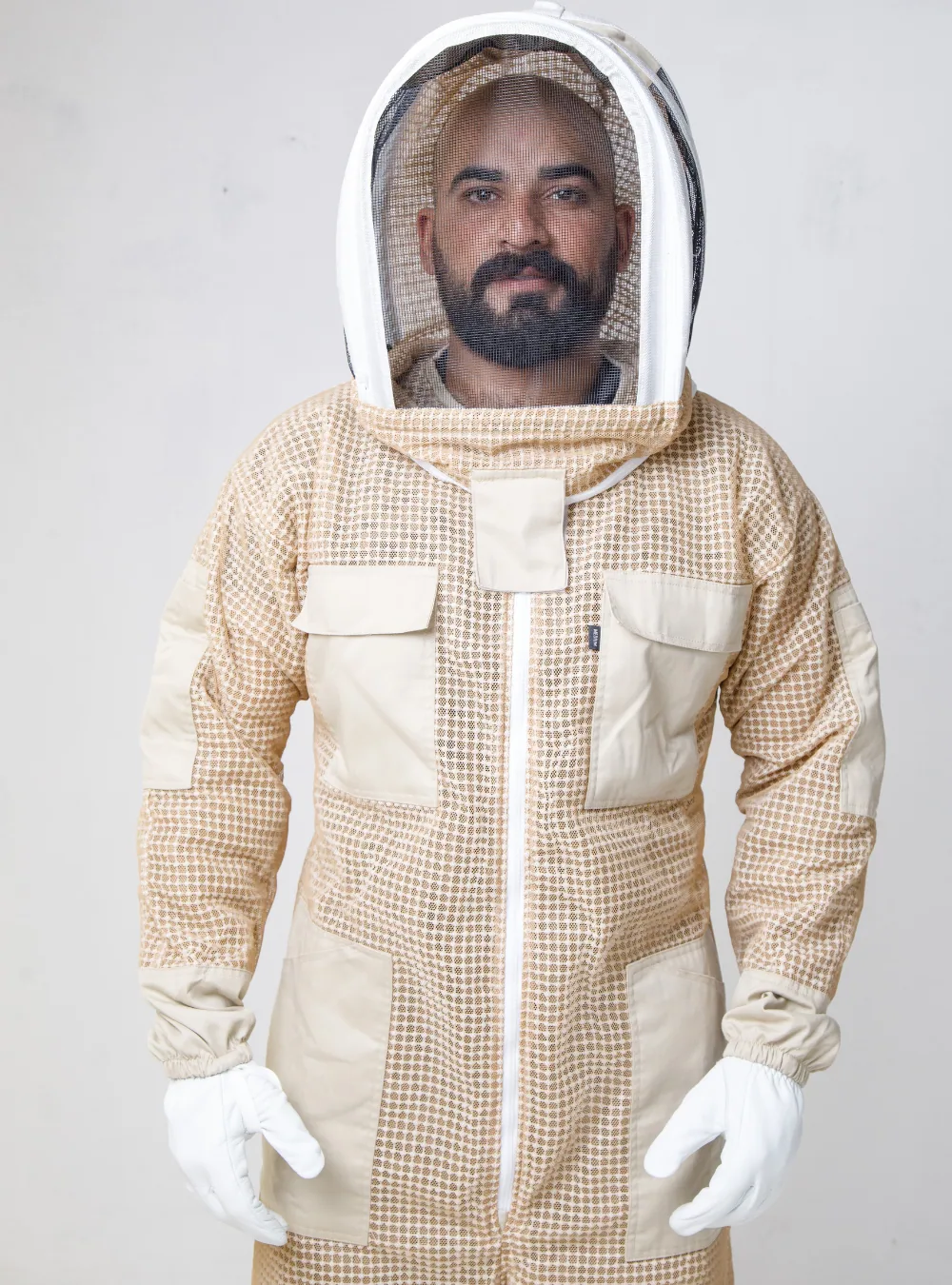
Press the fabric either side of the damage between finger and thumb. On a ventilated suit it should feel springy and push back. If it squashes flat and stays flat, the bonded layers have gone and the panel is now effectively single-layer — which is the whole mechanism by which a suit stops a sting.
A tear through springy fabric is worth repairing. A tear through fabric that has already collapsed is a symptom, not the problem.
What to repair, and what it needs
| Damage | Worth repairing? | How |
|---|---|---|
| Snag or small hole in veil mesh | Yes, immediately | A few stitches in fine thread, or a mesh patch. Do not leave it. |
| Seam come apart | Yes | Restitch. Anyone who alters clothes can do it. |
| Tear in cotton or polycotton | Yes | Patch from behind, stitch round twice |
| Tear in outer mesh, fabric still springy | Yes | Patch over, generous overlap |
| Worn-through knees | Yes | Patch, and reinforce before it happens again |
| Slack cuff elastic | Yes — not a tear, but the commoner fault | Replace the elastic |
| Broken zip | Usually | New slider, or a new zip tape |
| Flattened, delaminated mesh | No | Nothing restores the gap. Replace the suit. |
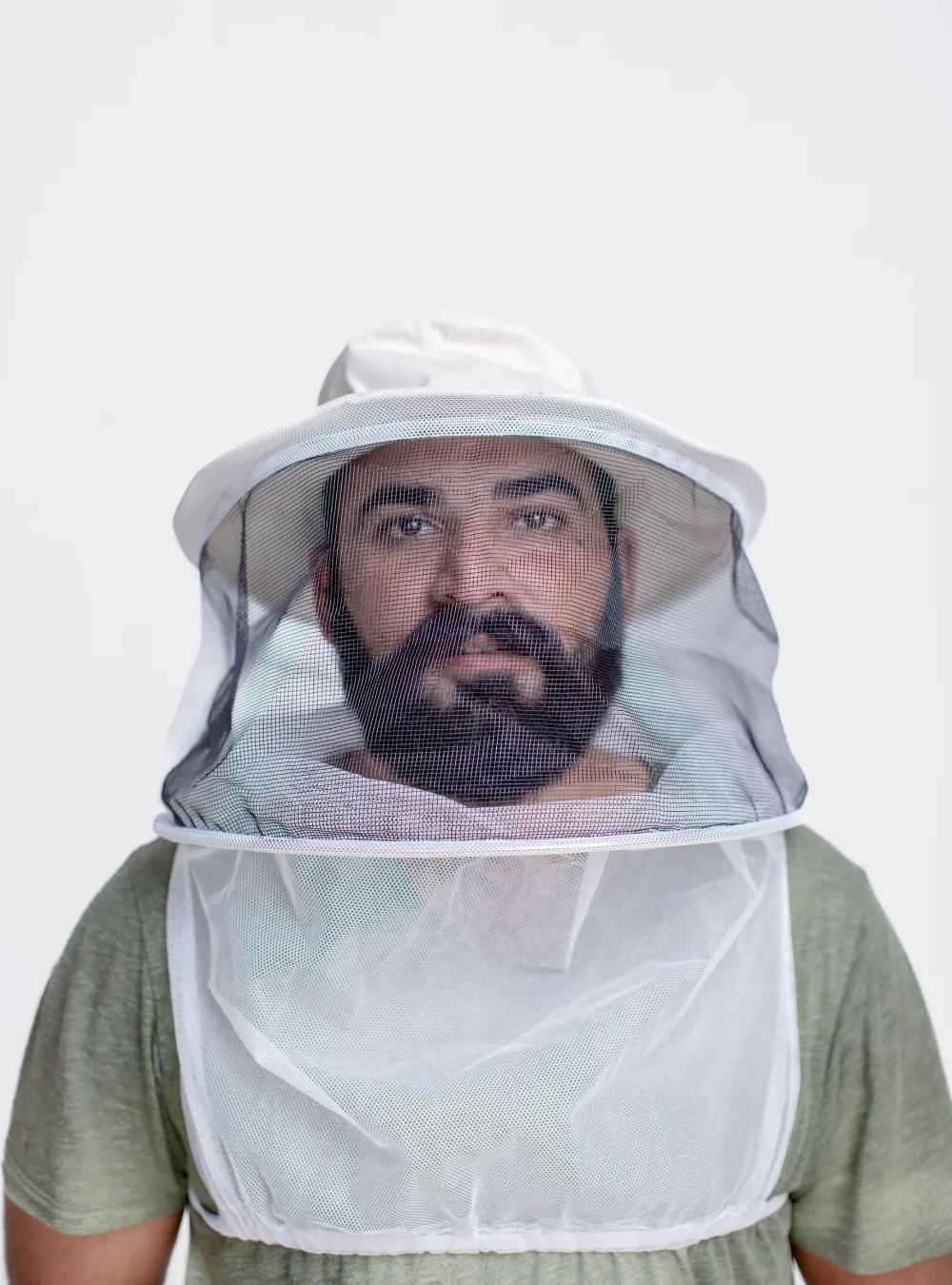
Repairing a torn bee suit veil
The most urgent and the most delicate, and it is what a bee in your veil usually means. A centimetre of damage becomes a hole within a season, because mesh frays from the cut edge outwards.
For a snag with no hole, a few stitches in fine thread pulling the strands back together is enough. For an actual hole, cut a patch of similar mesh a good two centimetres larger all round and stitch it down flat — the overlap is what stops the edge fraying again.
Two cautions. Do not use glue or iron-on patching on mesh: both stiffen it, and a stiff patch in front of your eyes is worse than a stitched one. And do not patch the face panel if you can avoid it — a patch across your line of sight defeats what the mesh is for. Replacing the veil is usually the better answer for face-panel damage, and on most suits the veil comes off.
How to repair a torn bee suit in cotton
Straightforward, and the one place ordinary clothing repair applies directly.
To repair a torn bee suit in cotton, patch from the inside with similar-weight cloth, overlapping the tear by two or three centimetres, and stitch round twice. From the inside, because an outside patch catches on hive furniture and lifts at the edges.
Iron-on patches work on cotton and are a reasonable quick fix. They stiffen the area and they come away eventually, so treat them as temporary and stitch when you have time.
How to repair a torn bee suit in ventilated mesh
Harder, because you are repairing a sandwich rather than a sheet, and because you must not compress it.
Patch over the outside with similar mesh — on a ventilated suit an outside patch is the right way round, since stitching from inside would pull the layers together and flatten the gap exactly where you are trying to restore it.
Use a generous overlap, stitch loosely rather than tightly, and accept that the patched area has slightly less standoff than the rest. That is fine on a sleeve or a knee. It is not fine over a shoulder, where compression already costs you.
What to keep in a bee suit repair kit
Five things, and they cost very little together.
- A square of spare mesh. Cut from an old veil or bought as a patch. The one item you cannot improvise.
- Strong polyester thread and a sharp needle. Cotton thread rots; polyester does not.
- Spare elastic in the width your cuffs use.
- A square of similar-weight cloth for cotton patches.
- A seam ripper, because most repairs start by undoing something.
Keep it with the suit rather than in a sewing box. A repair you can do the evening you find the tear is a repair that happens.
The repairs worth paying someone for
Zips and cuff elastic. Both are fiddly, both are cheap for an alterations shop, and both are the faults most likely to end a suit that is otherwise sound. A hood zip in particular runs round a curve and is not a first sewing project.
Before paying, check whether the maker sells the part. A supplier that sells replacement veils, cuffs and zip pulls has decided its suits should be repaired — which tells you more than a warranty length does.
Before you wear it again
- Scrape off any propolis around the tear first, cold, so the patch sits flat.
- Hold the whole garment up to the light, not just the repair. Where one thorn caught, others did.
- Check the repair from both sides, and that no thread end is loose inside.
- Put it on and move — reach, crouch, kneel. A patch that pulls will tear again at its edge.
- Wash it if the tear happened during a bad visit, because the suit is carrying alarm scent. Wash it cool, veil out.
Stopping the next one
You repair a torn bee suit far more often than you wear one out. Most tears are caught rather than worn: a thorn, a nail, a splinter on a hive stand, a washing machine with a zip in it. Three habits prevent most of them. For guidance on apiary equipment and upkeep from somewhere with nothing to sell, Penn State Extension’s beekeeping resources and the University of Georgia Bee Program are the right sort of source.
Wash the veil separately or by hand. Keep the suit off the ground when you are not wearing it. And check it against the light at the end of each season rather than at the start — before storage, when a found fault means months to order a part rather than a cancelled inspection.
If the repair list is getting long, that is worth reading against how long a bee suit lasts: everything except the mesh structure is a part, and a suit whose parts can be bought lasts far longer than one whose cannot. Our veils are sold on their own for exactly that reason.