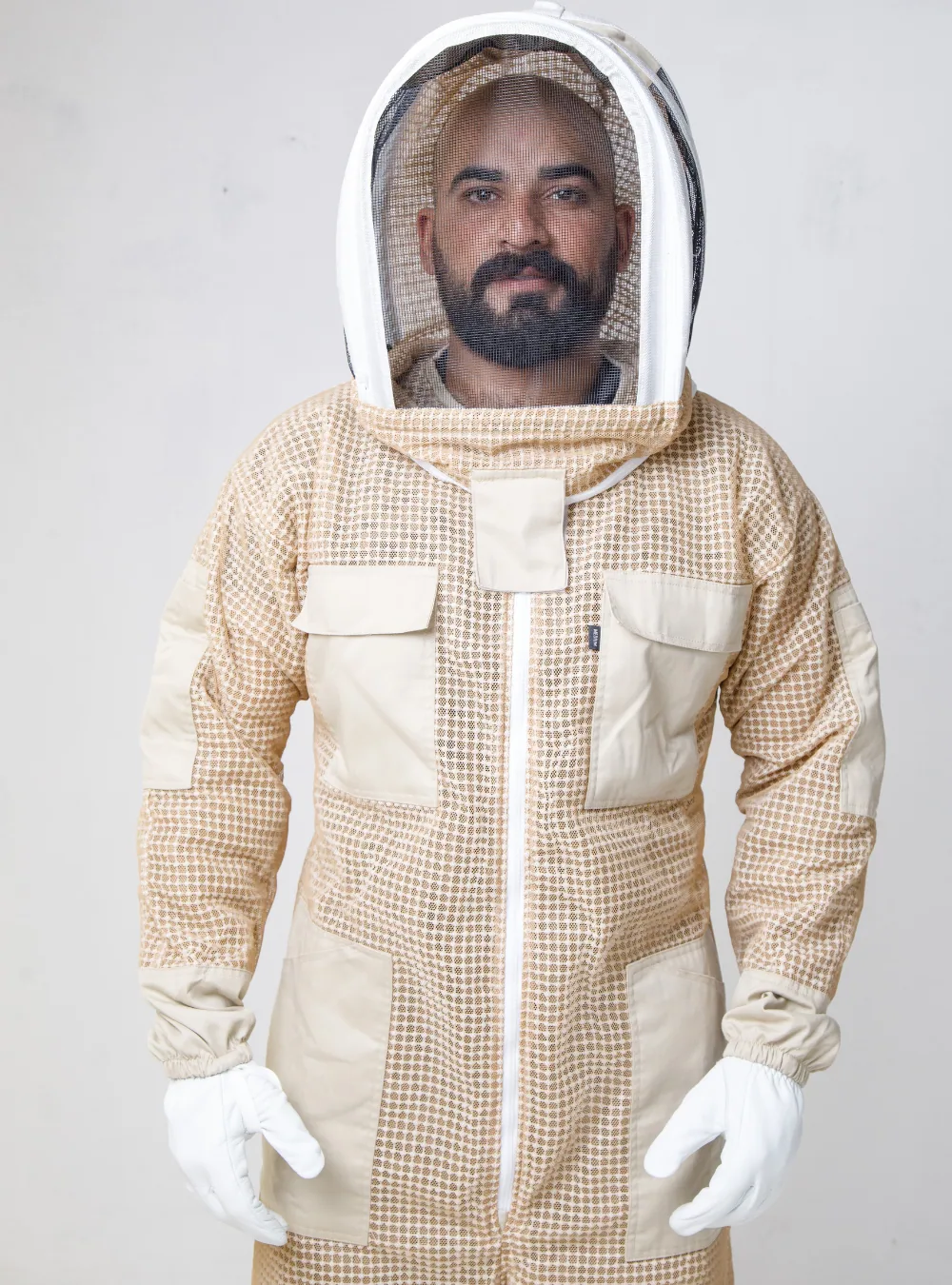
Beekeeping jacket and trousers set or full suit?
A jacket and trousers set is easier to wash, easier to size and cooler to work in. A full suit has no waist to fail. Which one is right depends on whether you kneel.

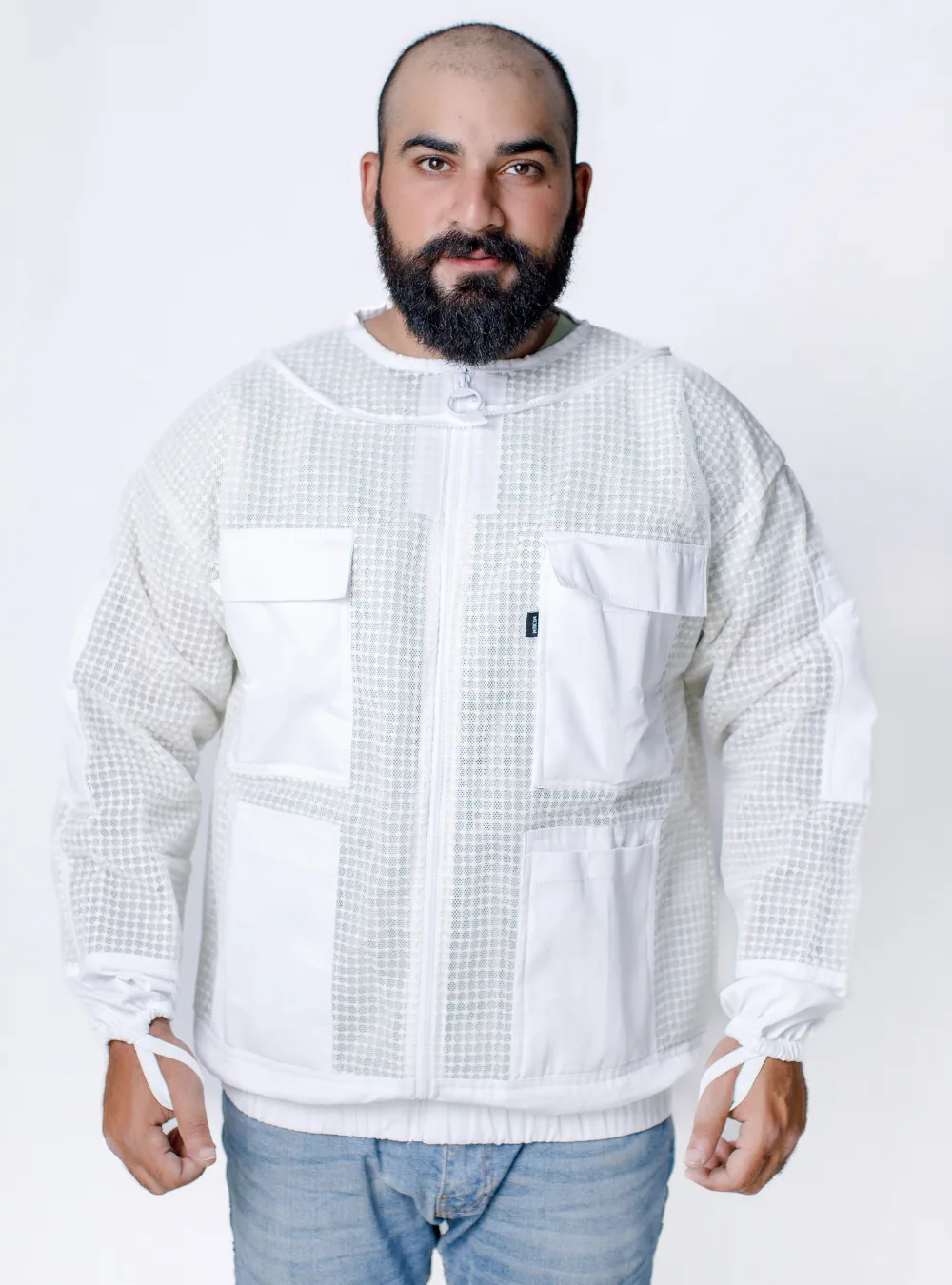
A beekeeping jacket and trousers set is two garments doing the job of one. The jacket carries the veil and covers you to the hip. The trousers cover the rest. It sizes better than a coverall, washes in halves, and runs cooler. It also has one weakness a full suit does not: a join at the waist.
Whether that join matters comes down to one question. Do you kneel?
What a jacket and trousers set actually is
Not a suit cut in half. Its jacket is longer than a normal jacket, with a drawstring or elastic hem meant to sit below the waistband of the trousers, and the trousers have a high rise and a wide elasticated waist.
Because of this, the overlap between them is the whole design. Twenty centimetres of jacket sitting over the trousers is a seal. Five centimetres is a gap waiting for you to bend forward.
Where a two-piece beats a one-piece
Four places, and they are real rather than marketing.
- Sizing. A coverall ties your leg length to your chest. A jacket and trousers set lets you buy a large top and a medium bottom, which is most people. Plus size fitting and suits for tall beekeepers both exist because of what a graded coverall cannot do.
- Washing. You can wash the trousers after a muddy apiary visit without washing the veil. Over a season that is a lot less wear on the mesh. Washing a bee suit explains why the veil is the part you want to launder least.
- Heat. A jacket alone is the coolest legal option for a quick look, and you can take the bottom half off the moment you are away from the hive.
- Replacement. Zips fail, and a zip failure on a coverall writes off the whole garment. On a set it writes off one half. Zip types and failures covers which ones go.
Where the full suit wins
One place, and it is the place that counts.
| Situation | Jacket and trousers set | Full suit |
|---|---|---|
| Standing, lifting a crown board | Fine | Fine |
| Bending forward over a brood box | Jacket rides up unless the overlap is generous | No join to open |
| Kneeling to lift a floor or a hive stand | Waist is the first thing to gap | No join to open |
| Reaching overhead to a swarm | Worst case for a two-piece | No join to open |
| Washing one half | Easy | Not possible |
| Buying two different sizes | Easy | Not possible |
Read that table as one trade. In other words, you are swapping a fit and laundry advantage for a seam that can open when your body changes shape. If your beekeeping involves a lot of kneeling and reaching up, the coverall is the honest answer. Suits for swarm collection says the same thing for the same reason.
Sizing a jacket and trousers set
Two garments means two sets of measurements, and the second one is the one people skip.
For the jacket, measure chest and sleeve. For the trousers, measure waist and inside leg, and then check the rise, which is the distance from waist to crotch. Rise is the measurement that decides whether you can kneel, and it is the one almost no size chart publishes.
How to measure for a bee suit gives the nine measurements. For a set, the ones that matter most are jacket length and trouser rise.
The gap at the waist, and how to close it
Three things, in order of how much they help.
- Buy the longest jacket you can. Hem at mid-thigh beats hem at the hip. This single choice does most of the work.
- Tuck the jacket in, not out. Counter-intuitive, but a hem inside a high elasticated waistband cannot ride up past it.
- Check it by moving. Put both on, then kneel, bend and reach up in front of a mirror. Any skin you see is a sting you will get. How a bee suit should fit uses the same test for a coverall.
Who should buy a jacket and trousers set
Three people, fairly clearly:
- Anyone whose top and bottom halves are different sizes. This is the strongest reason of the three.
- Anyone in real heat, who wants the option of the jacket alone away from the hive.
- Anyone sharing kit across a household, where two tops and two bottoms cover more bodies than two coveralls. A family beekeeping kit works out cheaper this way.
What we sell, and what we do not
We sell jackets and we sell full suits. We do not sell beekeeping trousers on their own, so we cannot sell you a matched set. That is a real gap and we would rather say so than pretend otherwise.
In practice, however, most people wearing a two-piece pair a jacket with their own heavy trousers, and that works if the trousers are pale, smooth and tight at the ankle. Whether you need beekeeping trousers at all goes through what your own clothes have to do. A ventilated jacket over jeans and boots is what a lot of experienced beekeepers actually wear in summer.
For general guidance on handling colonies in either, Penn State Extension and the University of Georgia bee programme are both reliable.