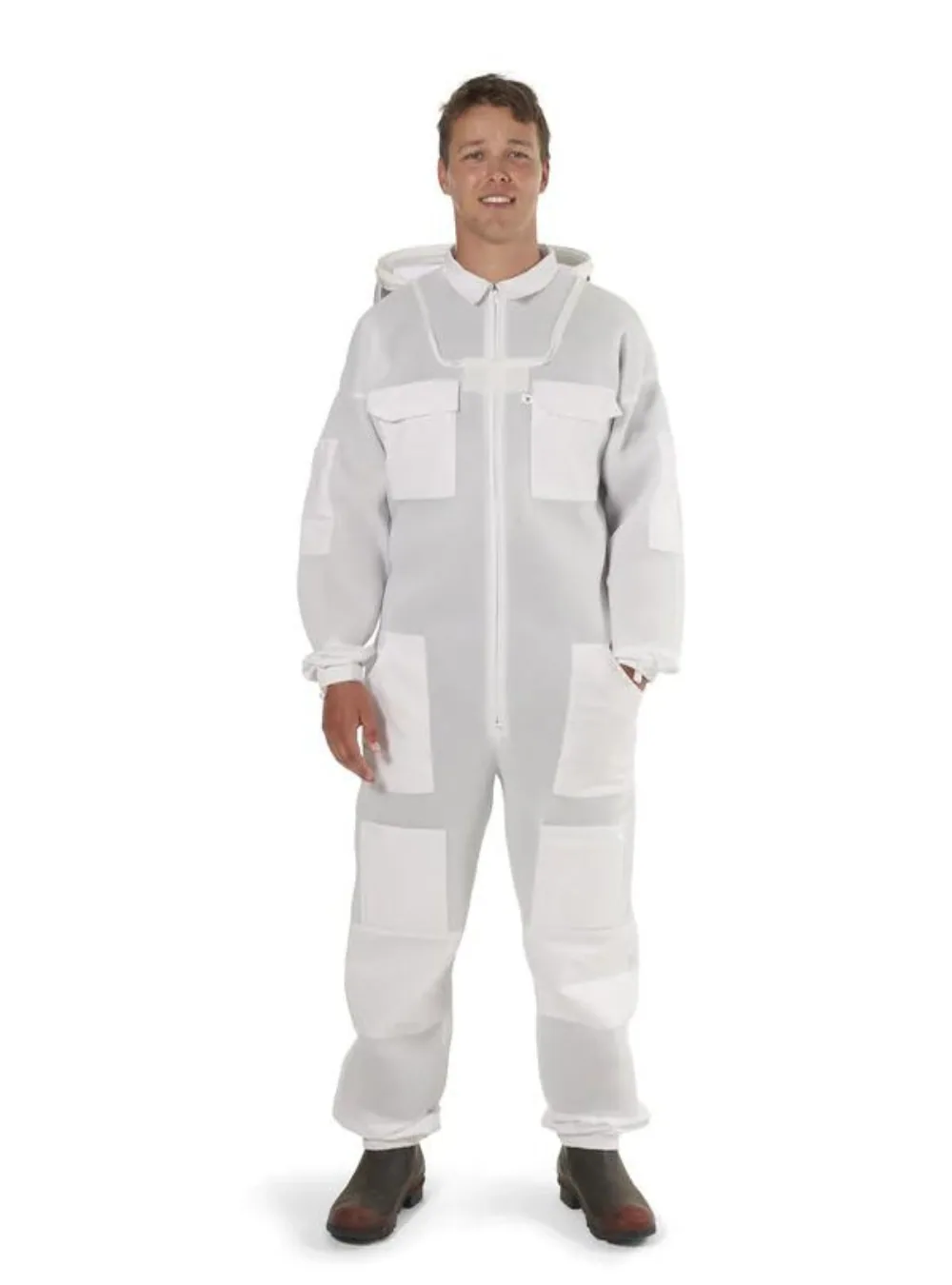
How to put on and take off a bee suit
Most suit-related stings happen in the two minutes after an inspection, not during it. The order you dress in matters; the place you undress in matters more.

Where you take off a bee suit decides whether the last five minutes of an inspection go well. Most suit-related stings do not happen at the hive. They happen afterwards, when someone unzips next to the colony with two or three bees still riding on their back.
Dressing has an order too, and it is not the order most people use.
Putting it on, in order
Boots first, then the suit, then the veil, then gloves. That sounds obvious until you watch someone try to pull boots on over sealed ankles.
- Thin layer underneath. One, not two. What to wear under a bee suit covers the choice.
- Boots on. Ankle-covering, and pale if you have them. Dark boots are a dark band at the height bees patrol.
- Suit on, ankles over the boots rather than tucked inside them. Water runs off, and bees cannot walk up.
- Zip the veil last, after your head is through and your hair is inside.
- Gloves last of all, cuffs over the sleeve or the sleeve over the gauntlet - which way round depends on gauntlet length.
Do all of it away from the hive. Dressing beside a colony means standing still, in their flight path, fiddling with a zip.
The check that takes ten seconds
Before you walk over, kneel down and reach up. Then look at your wrists, your ankles and your collar.
Any skin you can see is skin a bee can reach, and it is far easier to fix now than with the crown board off. The pre-inspection checklist is the longer version of this.
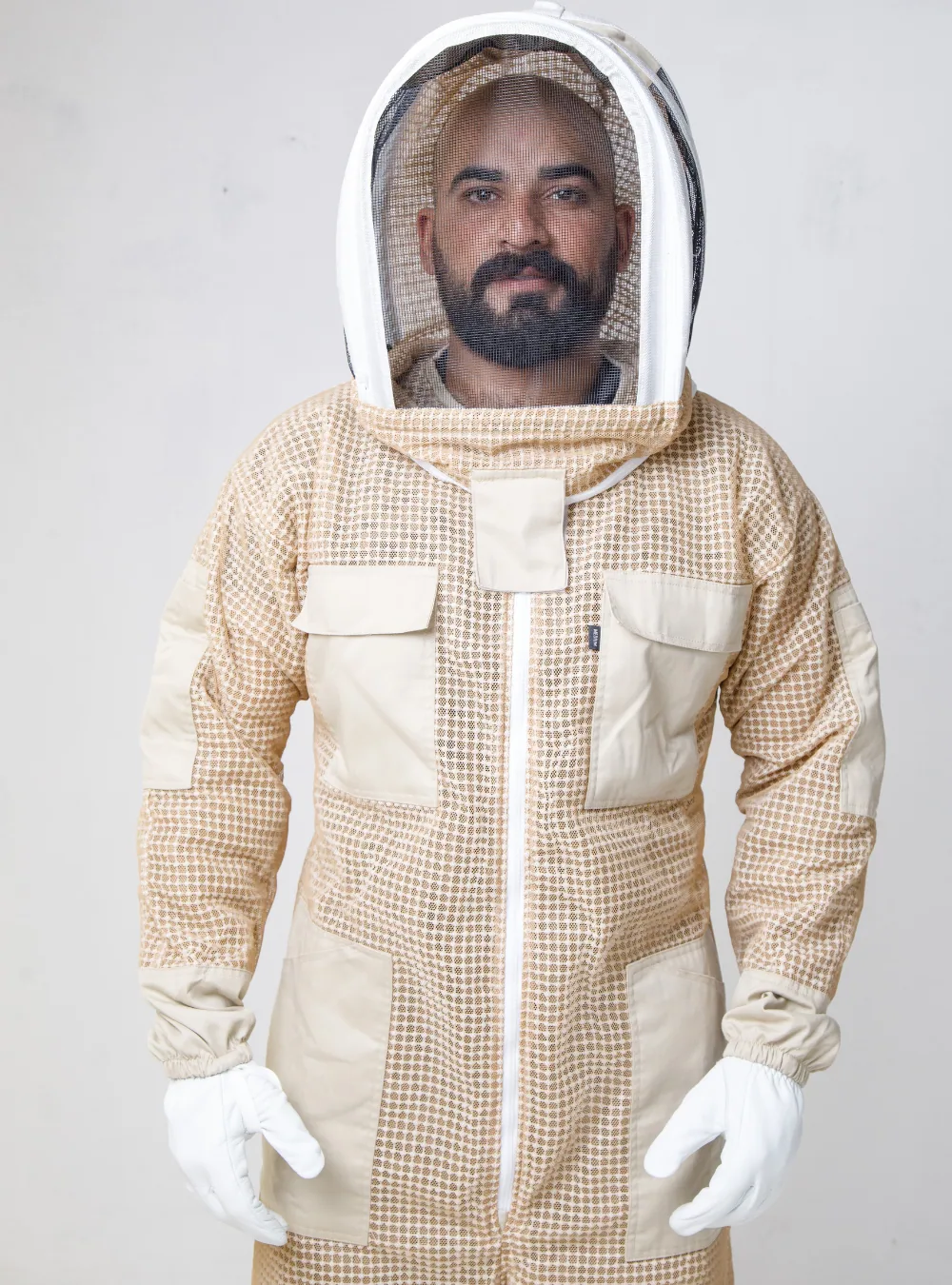
Where to take off a bee suit
Thirty metres away at least, and further if the colony was unhappy. Bees that followed you give up over distance, not over time, so waiting beside the hive achieves nothing.
Walking through long grass or round a hedge helps, because it breaks the line they are following. In practice the rule is simple: if you can still hear the colony clearly, you have not gone far enough to take off a bee suit.
Taking it off, in order
Reverse the dressing order, with one addition at the start.
- Brush yourself down first, with a bee brush or a gloved hand, back and shoulders especially. You cannot see the two places bees most often sit.
- Gloves off. They are the dirtiest part and you want bare hands for the zip.
- Veil off, slowly. Unzip and lift it forward over your face rather than pulling it back over your head, so anything on the mesh goes away from you.
- Suit off, inside out. Rolling it inward traps anything on the outside instead of releasing it at your feet.
- Boots last.
The two orders, side by side
Undressing is not the reverse of dressing, quite. The brush-down has no equivalent on the way in, and the veil comes off before the suit rather than after it.
| # | Putting it on | Taking it off |
|---|---|---|
| 1 | One thin layer underneath | Walk 30 m clear of the hive |
| 2 | Boots | Brush down back and shoulders |
| 3 | Suit, ankles over the boots | Gloves |
| 4 | Veil, hair inside, zipped | Veil, lifted forward not back |
| 5 | Gloves | Suit, rolled inside out |
| 6 | Check by kneeling and reaching | Boots |
Row one on the right is the one people skip, and it is the row that matters most.
The mistake almost everyone makes once
Taking the veil off first because it is hot, while still holding a frame or standing over an open box. Your face is then the only unprotected thing at the hive, at the height bees investigate.
If you are overheating badly, close the hive and walk away before anything comes off. Staying cool in a bee suit is mostly about not getting to that point.
When a bee is inside before you start
It happens, usually from a suit that was hung up outside or left in the car boot. Shake the suit out before you put it on, and look inside the veil rather than feeling inside it.
If one gets in while you are wearing it, getting a bee out of your veil is its own small procedure and worth reading before you need it.
After you take off a bee suit
Hang it somewhere airy rather than folding it into a bag. A suit packed damp with sweat goes stiff, and alarm pheromone on the fabric makes the next inspection worse.
If you are going on to another apiary, that is a different question with a stricter answer - bee suit biosecurity between apiaries covers it.
The short version
Dress away from the hive, in that order, and check by moving. Walk well clear before anything comes off, brush down, then take off a bee suit from the gloves inward. The whole routine adds about two minutes and removes most of the stings beginners get.
A suit with sealed ankles and a zipped collar makes all of this easier, which is what the three-layer suits and the VentGuard suit are built around. For general handling guidance, Penn State Extension and the University of Georgia bee programme are both sound.