
Bee suit for bee removal professionals
Removal work is not beekeeping with a different name. You are in confined spaces, at height, with a colony being taken apart around it — and the suit has to answer all three.

Wasp and hornet nests are a different job again — bee suits for wasps covers why. A bee suit for bee removal has to do three things an apiary suit does not: hold up under a much higher sting load, survive being dragged through confined spaces, and stay safe to wear on a ladder. A good apiary suit fails the second and third of those, which is why removal professionals end up buying differently from hobbyists.
Why an apiary suit is the wrong bee suit for bee removal
An apiary suit is designed, above all, for a managed colony you have smoked and are handling gently. A cut-out is the opposite: you are taking a structure apart around a colony that is defending it, often for an hour or more, with no option to walk away and come back tomorrow.
Three consequences follow.
Sting load. A defensive colony in a wall covers you. A single-layer cotton suit relies on slack fabric to hold the surface away from skin, and slack is exactly what you lose when you are pressed against a joist.
Abrasion. Insulation, roofing felt, brick edges, nails, splintered batten. Nothing in an apiary is like it. Lightweight mesh snags, and a snag in a veil is a hole.
Heat. A loft in summer is the hottest place anyone works in a bee suit, and you cannot shorten the job because the customer is waiting.
What to specify in a bee suit for bee removal
| Feature | Why removal work needs it |
|---|---|
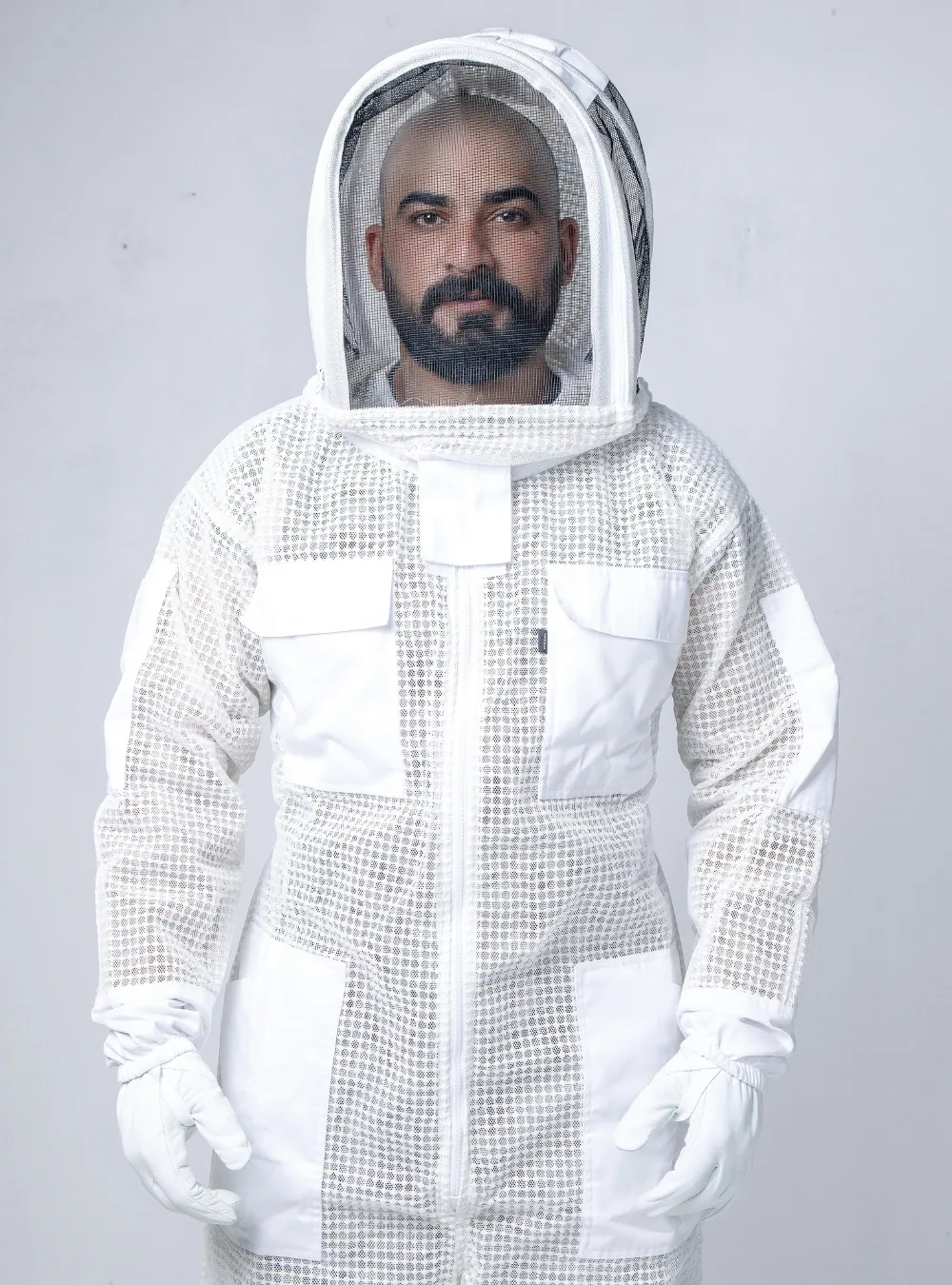
| Three-layer ventilated construction | The gap between layers holds the outer surface off your skin when you are pressed against something. It is also the only real answer to loft heat. |
| Full coverall, not a jacket | You kneel, crawl and sit on joists. A jacket leaves the half of you in contact with the structure unprotected. |
| Elasticated ankles and thumb loops | Both openings ride up when you crawl. Thumb loops are the only closure that holds a cuff down through a reach. |
| A veil with real standoff | You spend the job looking up into a cavity, which is the position that brings mesh closest to the face. |
| Nothing that catches | External pockets, loose straps and dangling zip pulls snag on nails and on ladder rungs. |
| Reinforced or patchable knees | You kneel on grit for an hour at a time. This is what wears out first. |
On the first row: three-layer versus two-layer mesh explains what the extra layer does. On the last row but one the point is not tidiness — a snag at the top of a ladder is a fall, and a fall is a worse day than any number of stings.
Coverall or bee suit?
Removal professionals often reach for a trade coverall instead of a bee suit because it is tougher. It is, and it is also single-layer, which means it has no standoff at all. The right answer is a bee suit built for abrasion rather than a coverall that was never built for stings — bee suit versus coverall sets out why in detail.
However, the hybrid some crews use is worth knowing about: a ventilated bee suit for the colony work, with a cheap disposable coverall over the top for the destructive part of the job. The outer layer takes the insulation, the dust and the snags, and gets thrown away. It is not elegant and it works.
For bee removal, the veil is the part to spend on
Removal work puts a veil in the worst position there is: looking upward into a cavity, with bees above you rather than in front of you, for a long time.
Consequently that argues for a round veil over a fencing veil, even though a fencing veil is faster and clearer, because the standoff at the crown and shoulders is where the difference shows. Fencing versus round covers the trade; the fencing veil in detail is worth reading if you would rather keep the visibility.
Either way, carry a spare, and prefer a dark face panel — black mesh is what you can see through when you are looking up into a dark cavity. Otherwise a torn veil ends a job, and a job ended halfway is a customer with a wall open and bees in it.
Removal is also the part of beekeeping with the most local variation in what you are permitted and expected to do. Extension services are the place to check that rather than a supplier — Penn State Extension's beekeeping resources and the University of Georgia Bee Program publish regional guidance.
Bee removal at height
Meanwhile the suit becomes a safety-equipment question the moment you are on a ladder, and it is worth thinking about separately.
- Tape the wrists and ankles for a cut-out — sealing them is a different job from an apiary visit.
- Anything that dangles can catch a rung. Tuck or remove zip pulls, straps and ties before you climb.
- A veil you cannot see your own feet through is a veil you should not be climbing in. Test it on the ground first.
- Ventilated mesh is slippery against a ladder stile. Do not rely on the suit for grip anywhere.
- A suit that is too large bunches behind the knee. On a ladder that is a trip hazard, not an annoyance.
This is the one place where a suit cut to your measurements earns its cost quickly — a measured suit can be made with the reach you need overhead without the extra width you get from buying a size up.
What fails first, in practice
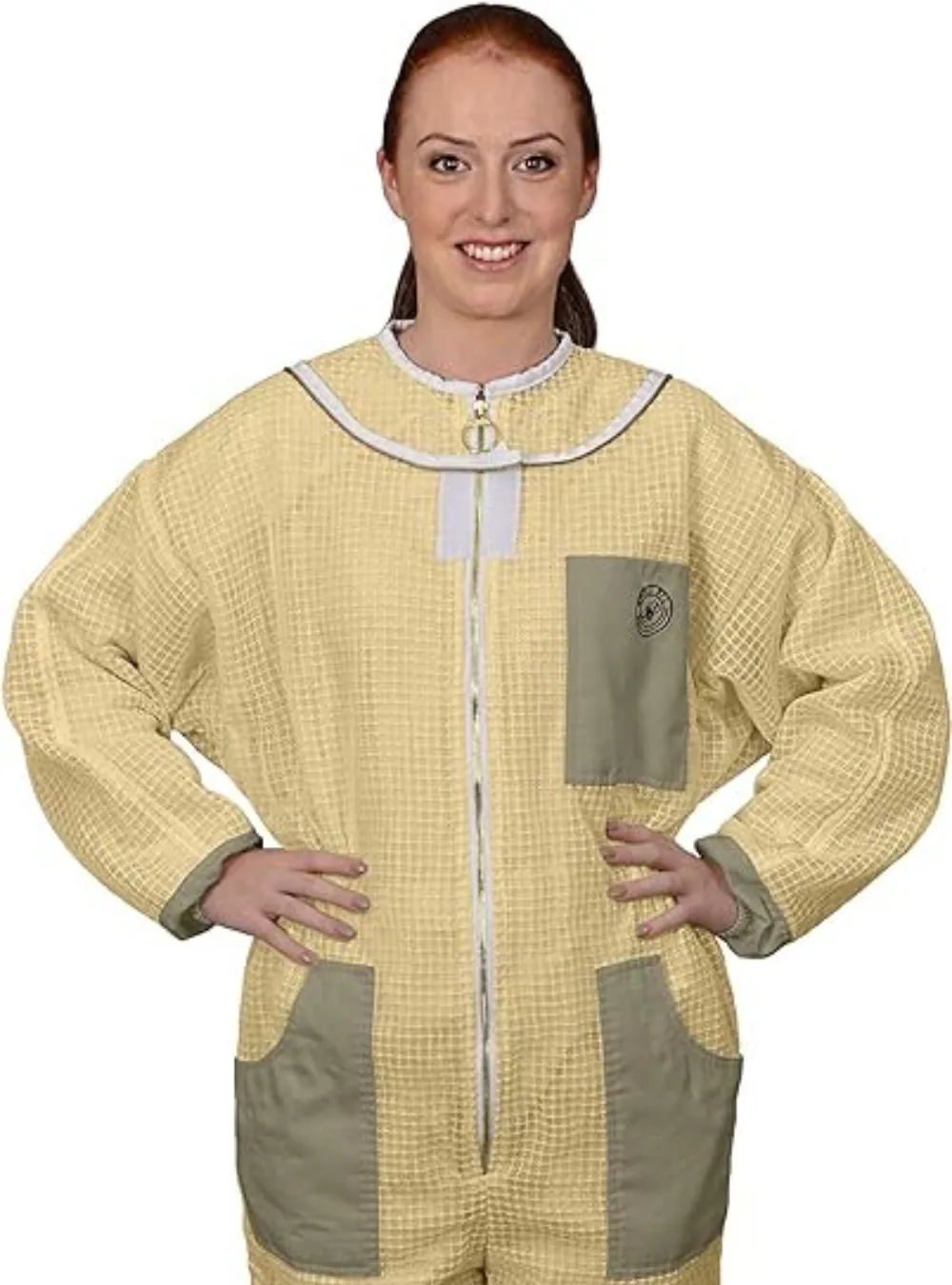
- Knees. You kneel on grit. Expect to patch or reinforce them.
- The veil zip. Opened and closed many times a day with sticky gloves — the slider is what goes.
- Cuffs. Elastic loses its grip long before the fabric wears out, and a slack cuff is an open sleeve.
- The seat. Sitting on joists and shuffling along them.
- Mesh at the elbows. The part that meets brick when you reach into a cavity.
None of those is a fault; rather, it is what the work does to a garment, and how long a suit lasts is a different question in this trade than in an apiary. Plan for it, keep a second suit so a damaged one is repaired rather than worn damaged, and check before buying whether cuffs and veils can be ordered on their own. That question matters more than a warranty length, for the reasons set out in what to check in a warranty.
Two suits, not one: a bee suit for bee removal and one for inspections
A bee suit for bee removal and a bee suit for inspections are different purchases, and trying to buy one garment for both is how crews end up with something that does neither well.
Swarm calls are a third job again — a suit for swarm collection is chosen for reach rather than sting load. The arrangement most removal businesses settle on: a tough ventilated coverall for cut-outs, and a lighter jacket for swarm collections and inspections. A swarm on a fence post does not need the loft suit, and wearing the loft suit for it wears it out on easy work.
In addition, the second suit is your redundancy. A suit that needs a repair gets repaired, instead of being worn with a hole in it because there is a job booked tomorrow.
What the customer sees
Worth a paragraph, because it is money, and it is also the one argument for khaki or cream over white — colour in hot climates covers the rest of that choice. You are arriving at somebody's house to do something that frightens them, and the suit is the first evidence they have that you know what you are doing.
Clearly, a clean, intact, properly fitted suit reads as competence. A stained one held together with tape reads as the opposite, however good you are — and propolis staining will not wash out of a white suit, which is one practical argument for khaki or cream in a commercial setting. Keep one presentable suit for quoting visits if nothing else.
Kitting a crew
Finally, if there are two or more of you, size each person properly rather than buying a shared pool — removal work is too long and too hot to spend in somebody else's suit. Beyond that, the useful shared stock is spares: veils, cuffs, gloves in a range of sizes, and one complete suit nobody is assigned to.
Our three-layer ventilated suits are the construction described above, the custom-fit suit can be cut with the reach you need for overhead work, and the wholesale page is the right place to start if you are kitting out a crew.