
Buying guides9 min read
Bee Suit Between Sizes: Which to Pick, and the Few Times to Size Down
Between two bee suit sizes, take the larger one. A slightly big suit still protects you; a slightly small one pulls tight where stings get through. Here is how to handle the awkward cases.

Caught with a bee suit between sizes? The answer is almost always the same: take the larger size. A bee suit protects you by holding cloth away from your skin, so a slightly big suit still works, while a slightly small one pulls tight across the shoulders, seat and knees, exactly where stings get through. Size down only when the larger size would be baggy everywhere.
Short answer: between two sizes, choose the larger one. If your chest and height point to different sizes, choose the larger of those too. The only real exceptions are gloves, and the rare case where the bigger suit would drag on the ground and gape at every cuff.
Key takeaways
- Size up by default. Too big costs you a little neatness. Too small costs you stings.
- When measurements disagree, the largest one wins. Spare chest room is harmless; spare leg length gathers at the ankle elastic over your boots.
- Test in motion. If the larger size passes the toe-touch, crouch and reach tests, it is the right size.
- Gloves are the exception. Too-big gloves make you clumsy; choose gloves by dexterity, not by the size-up rule.
- Far between sizes? That is what made-to-measure is for.
Why the bigger size is the safe size
The logic is the same one behind every piece of bee suit advice: distance is protection. A honey bee's stinger is short. It reaches you where the fabric lies against your skin and cannot reach you where there is air in between.
Every suit has more air in it standing still than it does when you move. Crouch, and the seat and knees pull flat. Reach forward, and the back goes tight across your shoulder blades. Bend to look into a brood box, and the body of the suit pulls the veil down toward your face. The smaller of two sizes reaches those limits sooner.
Texas A&M AgriLife Extension's rule is simple: "Bee suits and jackets should not fit tightly. While suited, the person should be able to touch their toes without the suit or jacket pulling tight along their back or pulling the veil against their face." (Texas A&M AgriLife Extension, ENTO-097) When you are between sizes, the larger one is far more likely to pass it.
Our size guide says the same thing in plain words: "Size up. A suit that is slightly too big still protects you; one that is slightly too small pulls tight across the shoulders — which is exactly where stings get through."
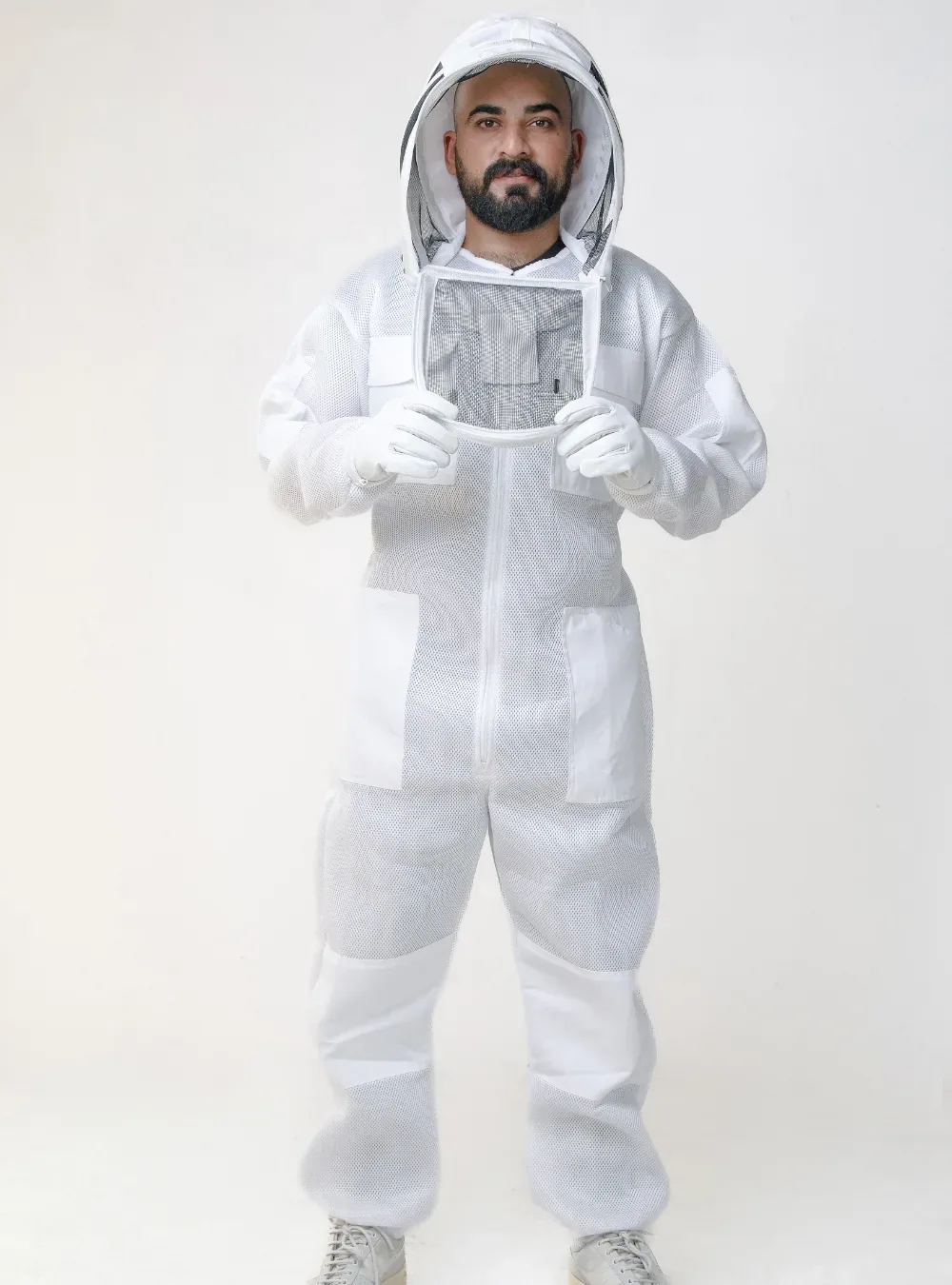
Bee suit between sizes: the common situations
| Your situation | Which to pick | Why |
|---|---|---|
| Every measurement is between the same two sizes | The larger | Room to bend, crouch and kneel |
| Chest says larger, height says smaller | The larger | A tight chest and back is the worse failure |
| Height says larger, chest says smaller | The larger | A short body pulls the veil onto your face when you bend |
| Long arms, average body | The larger, then check sleeves with gloves on | Short sleeves leave the wrist exposed when you reach |
| You wear thick layers in spring | The larger | Measure over the thickest layers you wear |
| Slim and short, and the larger size drags under your heels | Consider made-to-measure | Too long and too wide stops sealing and trips you |
| Gloves between sizes | The one you can work in | Dexterity matters; tight knuckles get stung |
Most of the table says the same thing. The two lines that differ, the last two, are where judgement comes in.
When your chest and height disagree
This is the most common version of being between sizes, and the answer is still the larger of the two. The reasons are slightly different in each direction.
Broad chest, shorter height. The suit that fits your height is tight across the chest and back. That is the failure you cannot fix: the cloth will be pulled flat against your shoulders every time you reach. The suit that fits your chest is a little long in the leg and body. On a suit with elasticated ankles, spare leg length gathers at the elastic over your boots, which is where it should be anyway.
Tall, slimmer chest. The suit that fits your chest is short in the body. Bending forward then drags the crotch up and the veil down, and the legs ride up off your boots when you crouch. The suit that fits your height has extra room at the chest, which costs you nothing but a little extra cloth.
In both cases, the smaller choice fails while you work and the larger choice only looks a little roomy.
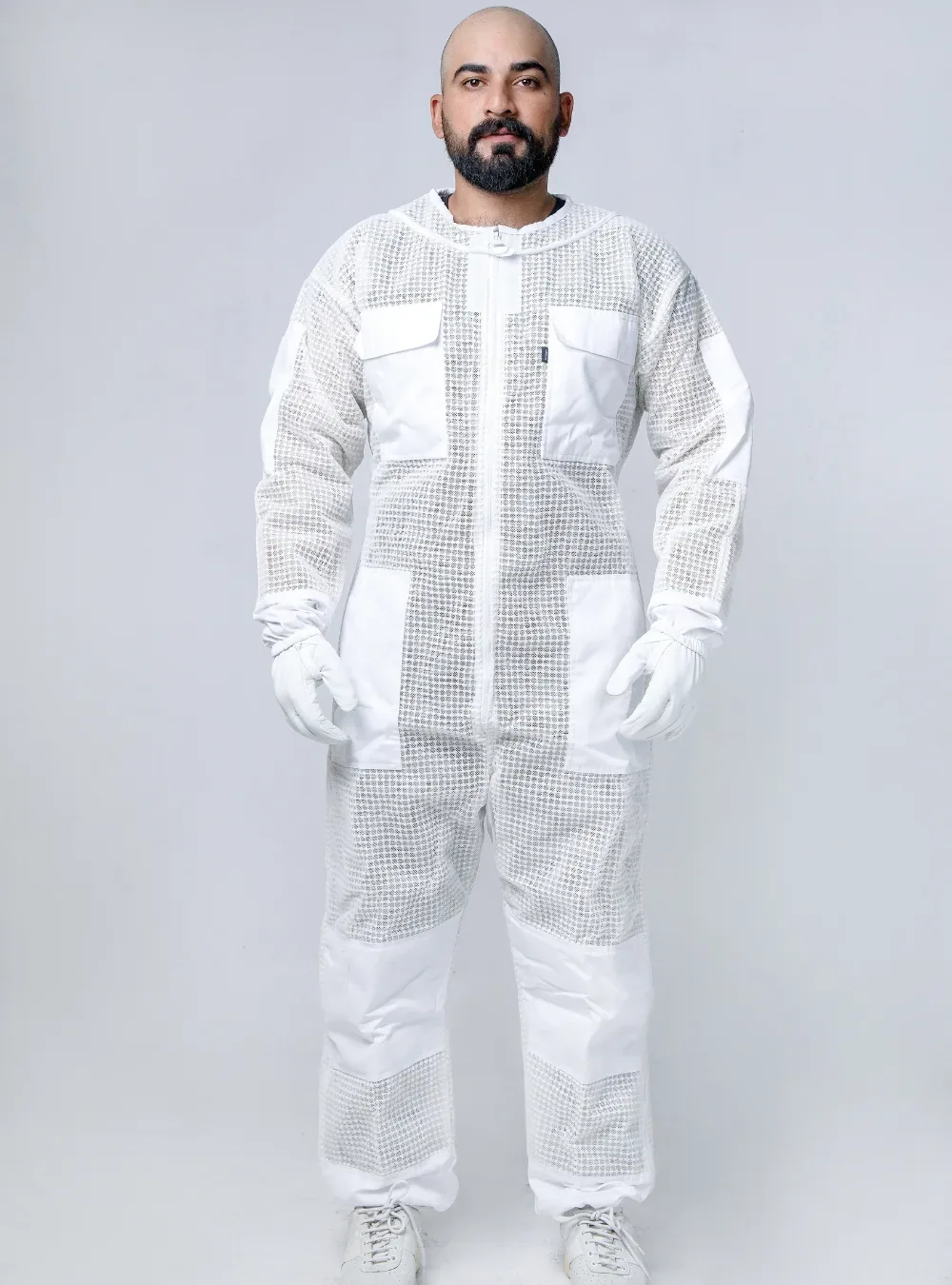
Sleeves and legs: the two lengths to check after sizing up
Sizing up solves tightness. It can leave you with sleeves and legs that are a little long, and both are worth a second look.
Sleeves. A slightly long sleeve is fine, because your gloves go over it. What matters is that the cuff stays inside the glove when you reach forward. Some suits and jackets help here: the University of Arkansas Cooperative Extension describes "an elastic loop sewn into the wrist. Place your thumb through this loop to keep your sleeves in place when you pull on your gloves." (Beekeeping Basics, University of Arkansas) If your suit has thumb loops, a long sleeve is no trouble at all.
Legs. The legs go over your boots, not into them; Texas A&M is clear that "the suit legs should be worn over shoes or boots — not tucked in." So a little extra length simply sits over the boot and gathers at the ankle elastic or zip. What you do not want is cloth dragging under your heel. Walk up and down a step in the suit. If your heel catches the hem, the legs are too long for safety, not just for looks.
Too short is worse than too long, on both. A short sleeve leaves your wrist exposed when you reach, and a short leg rides up your shin when you crouch. Those are the gaps bees use. That is the size-up rule again, from a different direction.
Hold off on alterations. It is tempting to shorten the legs of a new suit straight away. Wear it to the hive a few times first, in the boots you use, and see where the cloth actually sits when you crouch and kneel. A hem that looks long in the hallway is often exactly right at the hive.
Is one size too big a problem?
Usually not. One size up gives you more room to bend and kneel, which is the point.
The things that go wrong with a much-too-big suit are real, though, and worth knowing so you can tell whether you have crossed the line:
- Cuffs that will not seal. Wrist and ankle elastic that is too wide for you leaves gaps.
- Legs that drag under your heels. Cloth wears through, and you can trip on uneven ground while carrying a full box.
- Cloth that snags. Big folds catch on frame lugs, box corners and brambles.
- A hood that slides. A collar much bigger than your neck lets a zip-on veil sit off-centre.
If the larger size does none of those things, it is the right size. If it does all of them, read the next section.
The few times to size down
There are times the smaller size really is the better choice. They are rare.
The larger size is baggy everywhere. If you are slim and short, and the larger size drags under your heels, has cuffs you can pull your hand straight through, and folds over at the waist, then the larger size is not protecting you better. It is just bigger. Try the smaller size, and run the movement tests in it. If it passes, keep it.
You only wear it in summer over thin clothes. If you measured over spring layers but only ever inspect in a T-shirt, your true summer measurements may sit in the smaller size. Measure again in what you actually wear.
You are buying a jacket, not a suit, and only the body length is in question. A jacket's length matters at the waist: too short and it rides up when you bend. If the smaller jacket still covers your waist when you lean over a hive, it may be the better fit. If not, size up.
In every case, the test is the same. Put it on, touch your toes, crouch, kneel and reach. If the smaller size passes, it fits. If it pulls tight anywhere, go back up.
How to test the larger size before you commit
When the suit arrives, do not take the labels off until you have tried it properly:
Dress as you would at the hive. Your usual clothes underneath, your hive boots on.
Zip the veil and put your gloves on. Gloves go over the sleeves, pulled up high.
Touch your toes. No pull along the back, and the veil stays clear of your face.
Crouch and kneel. The legs stay over your boots, and the seat and knees do not stretch flat.
Reach forward with both arms. No skin shows between cuff and glove.
Walk around and climb a step. The legs should not catch under your heels.
If the larger size passes, it is your size. Our guide to how a bee suit should fit explains what to look for at each point.
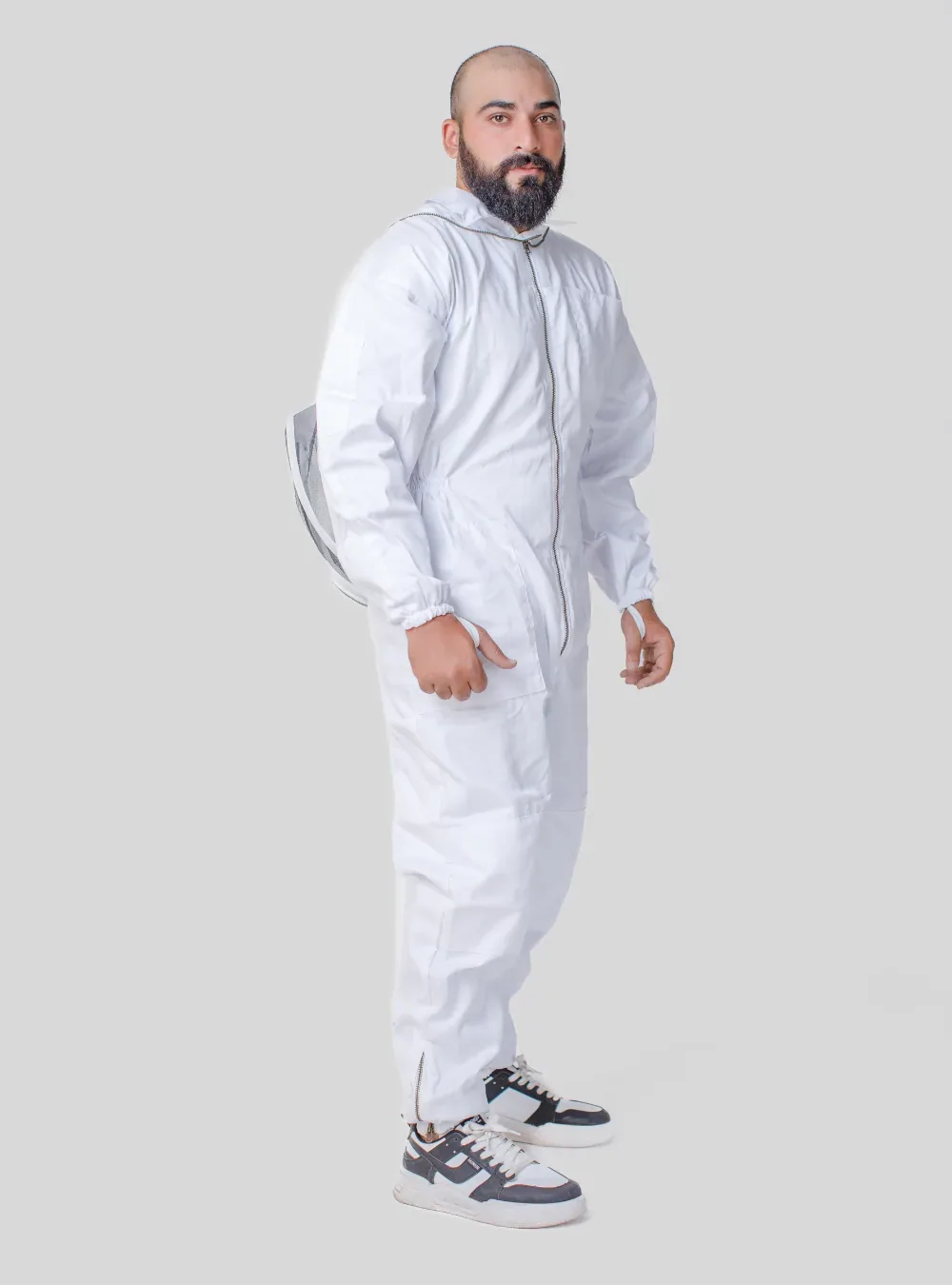
Gloves: the exception to the size-up rule
Gloves follow different rules, because a glove's job is different. A suit protects by keeping cloth away from you. A glove has to let you work.
Texas A&M puts the trade-off well: "Gloves rarely fit perfectly. When choosing gloves, it is important to remember that tighter-fitting gloves may result in stings on the knuckles, while larger gloves reduce dexterity."
So between two glove sizes:
- If the smaller size stretches tight over your knuckles when you make a fist, take the larger.
- If the larger size bunches at the fingertips so you cannot pick up a frame or a queen cage, take the smaller.
- Whichever you choose, wear the gloves over the sleeve and pull them as far up the arm as they go.
We compared glove materials in leather vs goatskin beekeeping gloves and nitrile vs leather beekeeping gloves.
Ventilated or cotton: does it change the answer?
No, but it changes how the larger size feels.
A three-layer ventilated mesh suit is thicker and springier than cotton. It holds its own shape, so in the same size it can feel less roomy. A cotton suit drapes and can feel roomier in the same size. Measure for both in the same way and apply the same rule: between sizes, go up. See ventilated vs cotton bee suits for how the two fabrics compare in use.
Children and growing beekeepers
For a child, the between-sizes rule is even more clearly "go up". Children can outgrow a suit quickly, and a suit that is right today may be tight next summer. But the "much too big" problems are worse on a child, too: legs that drag, cuffs that gape. Choose one size up, not two, and check the sleeves and legs with gloves and boots on.
Far between sizes? Skip the question
If your measurements are far apart, a broad chest with short legs, very tall and slim, or outside the usual range altogether, no ready-made size will fit everywhere. Every choice compromises somewhere.
That is what our custom-fit bee suit is for. It is cut to nine measurements: chest, waist, hip, height, inseam, sleeve, neck, shoulder and preferred ease. Our guide to how to measure for a bee suit shows how to take each one. If you are unsure whether your suit is too big or too small once it arrives, see the signs a bee suit is too big or too small.
Between sizes? Go up, or get it cut to fit
Ready-to-ship suits from X-Small to 5X-Large in cotton and ventilated mesh, or a suit made to your own measurements.
Common questions
Should I size up or down in a bee suit?
Size up. A bee suit protects by holding cloth away from your skin, so a slightly large suit still protects you, while a slightly small one pulls tight across the shoulders, seat and knees, which is where stings get through.
My chest is one size and my height is another. Which do I choose?
The larger of the two. Extra chest room in a suit chosen for height does no harm, and extra length in a suit chosen for chest gathers at the elasticated ankles over your boots. A suit too small in either direction pulls tight when you move.
Is a bee suit that is one size too big a problem?
Usually not. One size up gives more room to bend and kneel, which is what you want. Only go further if your measurements say so, because a suit several sizes too big snags, trips you and lets the cuffs gape.
When should I size down in a bee suit?
Rarely: only when the larger size would be baggy all over, with legs that drag under your heels and cuffs too wide to seal. In that case a made-to-measure suit is usually a better answer than the smaller size.
What if I am between sizes in beekeeping gloves?
Gloves are the exception, because gloves that are too big make you clumsy. Texas A&M notes that tighter gloves can mean stings on the knuckles while larger gloves reduce dexterity. Choose the size that lets you handle a frame without bunching, and never one that stretches tight over the knuckles.
Does the between-sizes rule apply to bee jackets too?
Yes. A jacket that is too small rides up at the waist when you bend, opening a gap. Size up, and check that the hem stays below your belt when you lean over.
Written by Alex, Bee suit maker, BEESUITWEAR · United States.
Writes about protective clothing from the workshop where the suits are made.