
Buying guides9 min read
Plus Size Bee Suit Fitting Guide: Room Where It Counts
A plus size bee suit has to give room at the chest, belly, seat and thighs without legs that drag and cuffs that gape. Here is how to measure, what to check, and when made-to-measure is the better answer.

A plus size bee suit has to do the same job as any other: keep the cloth away from your skin while you bend, crouch and reach. Choose it by your largest measurement, usually chest or belly, taken over the clothes you wear underneath. Then check what a bigger size can get wrong: legs that drag, cuffs that gape, and sleeves that leave your gloves.
Key takeaways
- Size by your largest measurement. Chest, belly or hip, whichever points to the biggest size.
- Room protects you. The gap between cloth and skin is part of the protection, at any size.
- Watch the ends. A larger size can be longer too: check legs, sleeves and cuffs with boots and gloves on.
- Heat matters more in a bigger suit. A three-layer ventilated suit is the cooler choice for summer.
- Almost all our suits and jackets run to 5X-Large, and a made-to-measure suit is cut to your own nine measurements.
Why plus size fit is about more than a bigger number
At every size, a bee suit protects you the same way. A honey bee's stinger is short. Where the fabric is pressed against your skin, a bee on the outside can sting through it. Where there is air between fabric and skin, it cannot reach you.
The University of Arkansas Cooperative Extension says suits "are sting-resistant, but they are by no means sting-proof." (Beekeeping Basics, University of Arkansas) What turns a suit from resistant into nearly useless is fabric stretched flat against you, and on a bigger body there is more of you to stretch it over: the chest, the belly, the seat and the thighs.
That is why "the size that closes" is not the same as "the size that fits". A suit that zips up while you stand can pull tight the moment you bend over a brood box. Texas A&M AgriLife Extension's test applies at every size: "While suited, the person should be able to touch their toes without the suit or jacket pulling tight along their back or pulling the veil against their face." (Texas A&M AgriLife Extension, ENTO-097)
How to measure for a plus size bee suit
Use a soft tailor's tape and a helper, and measure over the clothes you wear under the suit. Our full guide to how to measure for a bee suit covers all nine measurements. For a plus size suit, a few deserve extra care.
Chest. Around the fullest part, tape level under the arms. Stand naturally and breathe normally. Do not pull the tape tight.
Waist, at the navel. Not where your trousers sit. For many people this is the measurement that decides the size, because the main zip runs straight over it.
Hip. Around the fullest point of the seat. This is the measurement that matters when you squat.
Height and inseam. Barefoot. These tell you whether a larger size will be too long for you, which is the most common plus size fitting problem.
Sleeve. From the centre-back of the neck, over the shoulder, to the wrist, with the arm slightly bent.
Then compare. Whichever of chest, waist or hip points to the biggest size, that is your starting size. Height and inseam then tell you whether that size will be long, and whether a made-to-measure suit makes more sense.
Where a plus size bee suit needs room
| Area | What to check | Why it matters |
|---|---|---|
| Chest and belly | Main zip closes over your clothes and lies flat when you sit | A strained zip is a gap; tight cloth here takes stings |
| Shoulders and back | No pull across the shoulder blades when you reach forward | The back is where a tight suit fails first |
| Seat and hips | Room to squat without the cloth stretching flat | You squat at every inspection |
| Thighs and knees | Cloth not pulled flat when you kneel | Kneeling presses cloth onto the knee |
| Upper arms and forearms | Sleeve not tight when you bend the elbow | Tight sleeves pull back out of the gloves |
| Collar and veil | Veil zip closes flat; mesh clear of the face | A tight collar strains the veil zip |
| Wrists and ankles | Elastic grips without gaping or cutting in | Cuffs are the seals that keep bees out |
The plus size problem that often gets missed: length
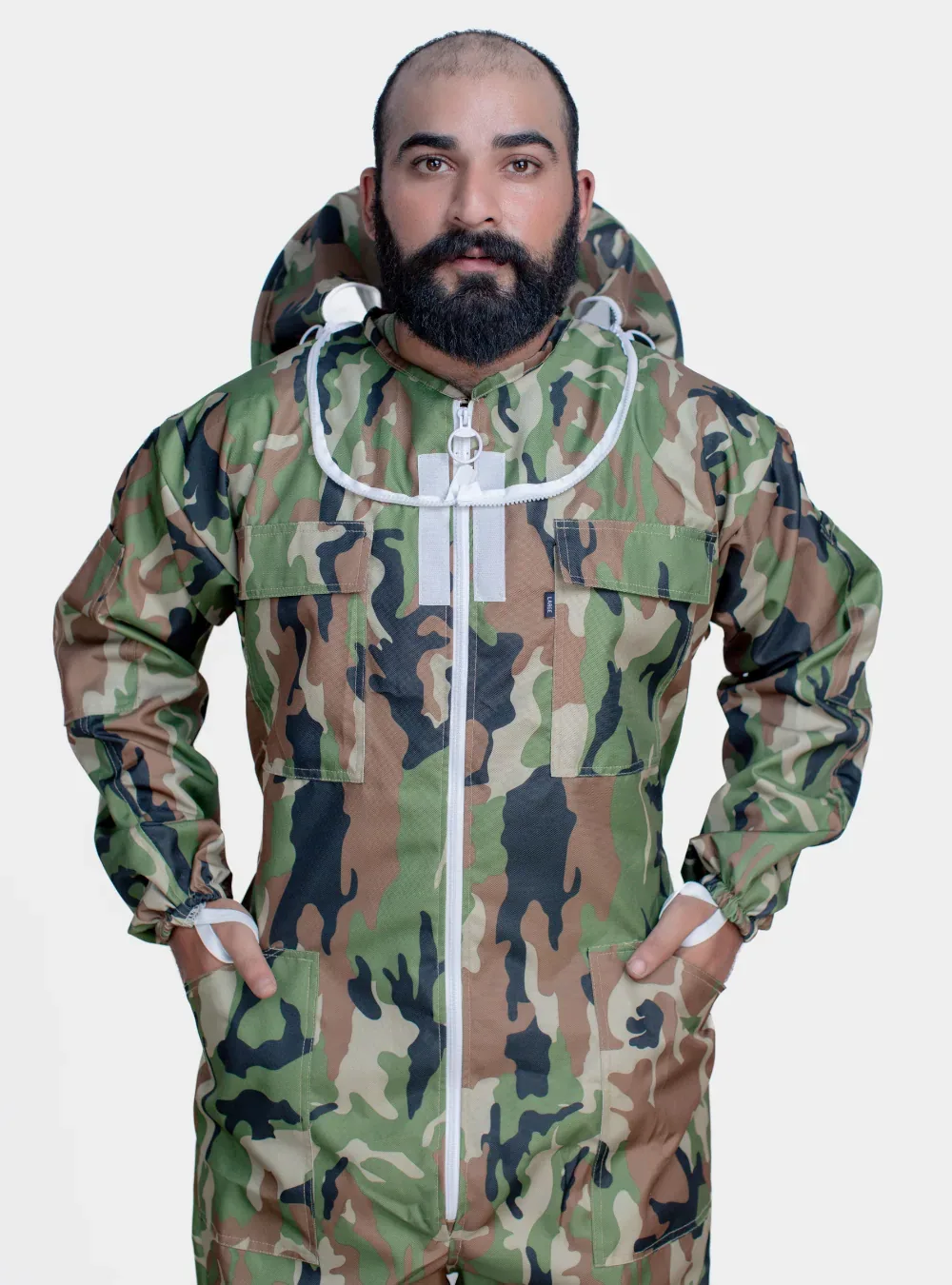
Ready-made sizes usually grow in length as well as width. So if you need a larger size for your chest or belly but are not especially tall, the legs and sleeves of that size may be longer than you need.
A little extra length is fine, and often helpful.
- Legs. Suit legs go over your boots, not into them; Texas A&M is clear that "the suit legs should be worn over shoes or boots — not tucked in." On a suit with elasticated or zipped ankles, a little spare length gathers over the boot, which is exactly where it should sit.
- Sleeves. Your gloves go over the sleeves and up the arm, so a slightly long sleeve disappears inside the gauntlet.
Too much length is a different matter. Legs that drag under your heels catch on steps, wear through, and can trip you while you carry a full box. Before you hem anything, wear the suit to the hive a few times in your boots and see where the cloth sits when you crouch. If it still drags, shorten the legs, or consider a suit cut to your own inseam.
Heat: choose the fabric for the work
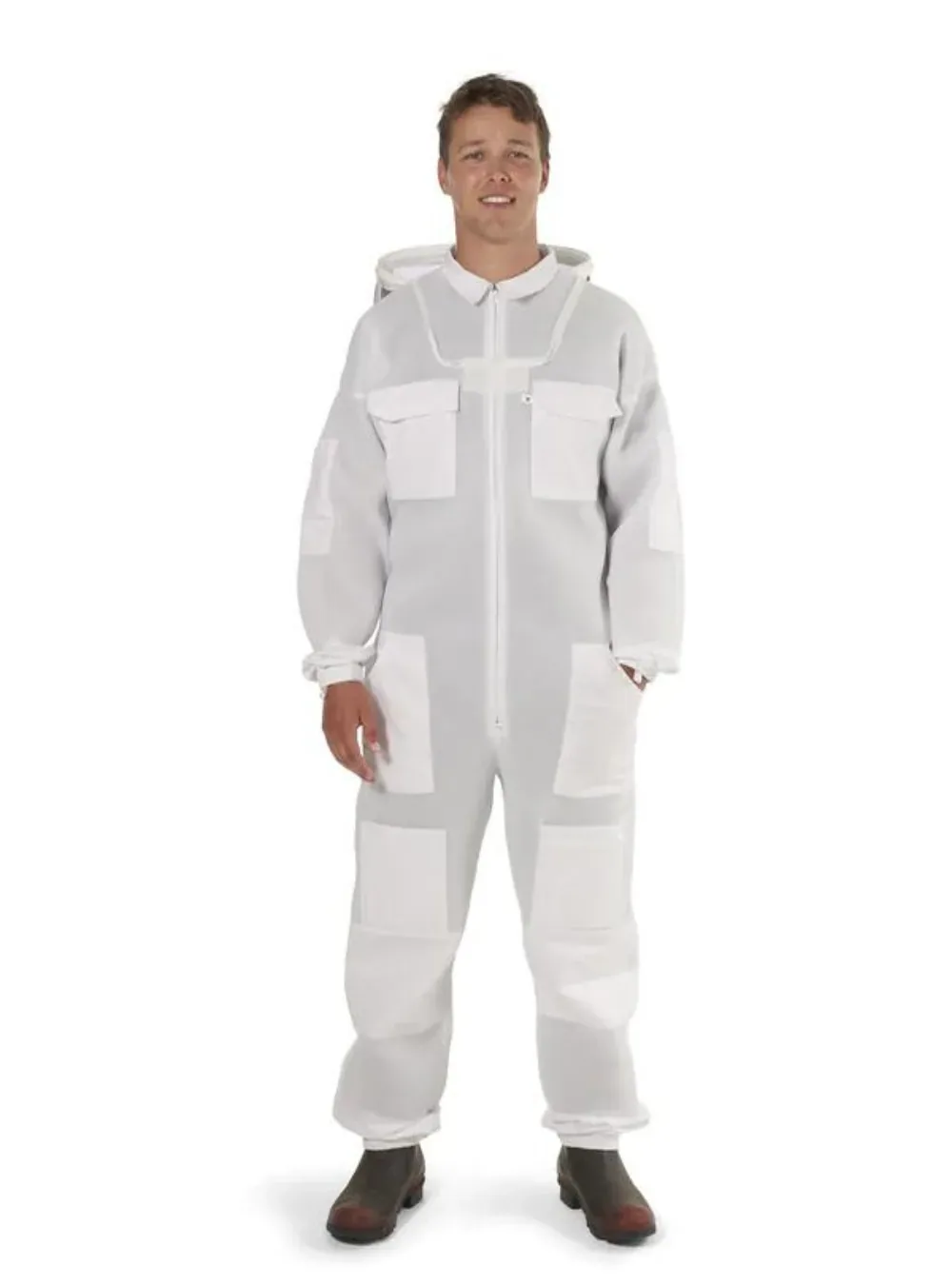
Bee suits are hot, and a bigger suit has more fabric in it. Texas A&M notes that "cotton canvas suits can be very hot in the summer months," and that vented fabric "is composed of layers of netting that allows air to flow and cool the body."
For summer inspections, long honey pulls or warm climates, a three-layer ventilated mesh suit is the cooler choice. Its thickness also holds the outer layer slightly off your skin, which helps the standoff that protects you, though it does not replace a loose fit. Our ventilated suits run from $100 to $140; most come in every size to 5X-Large.
For cool springs, a cotton or poly-cotton suit is warmer and more forgiving of brambles. Our cotton suits run from $90 to $120, again mostly to 5X-Large. We compared the two in detail in ventilated vs cotton bee suits.
Whatever the fabric, hang the suit to air after each use; Texas A&M warns that "a folded suit may mold."
Gloves for larger hands
Gloves go over the suit sleeve and as far up the arm as possible. For larger forearms, that means the gauntlet has to be wide enough to pull over the sleeve without straining.
Texas A&M sums up glove fit: "tighter-fitting gloves may result in stings on the knuckles, while larger gloves reduce dexterity." So size gloves by your hand, and check the gauntlet separately.
Our BeeGuard Spectrum five-pack of cotton goatskin gloves comes in sizes up to 5X-Large. Our other gloves run from Small to X-Large. For more on materials, see leather vs goatskin beekeeping gloves.
Suit or jacket?
A bee jacket is often easier to fit at plus sizes, because you only fit the upper body and wear your own trousers. Our jackets run to 5X-Large too.
The one thing to check on a jacket is length. Bend forward as if looking into a hive. If the hem rides up above your belt, a gap opens at the waist and bees will find it. A jacket needs enough length to stay down when you bend, which on a bigger body may mean a size up for length rather than width.
If you work defensive colonies, or do removals, a full suit is the safer choice at any size.
Getting in and out, and keeping it sealed
A suit that fits well can still be a struggle to put on, and a suit you struggle into is a suit you are tempted to leave half-zipped. A few habits make it easier at any size.
Sit down to dress. Put your boots on first, then sit on a chair or the tailgate and step into the suit legs one at a time. Many suits have zips at the ankles; the University of Arkansas Cooperative Extension describes suits "with elastic cuffs at the wrists, and zippers at the ankles and flaps to secure the zippers." Open ankle zips let the legs pass over your boots without a fight.
Zip the main zip with the suit pulled up. Lift the shoulders of the suit into place before you zip, so the zip is not taking the strain of a suit sitting too low. If the zip is hard to close over your belly while you stand, it will be under strain all through the inspection. That is a sign to go up a size.
Check every closure before you light the smoker. Texas A&M recommends you "double-check that all zippers are zipped, Velcro is attached properly, and legs are strapped and around the ankle properly." For defensive colonies, it notes that many beekeepers "use 1-inch tape to cover any accidental openings around zippers," because honey bees "can find and fit through small holes."
Undress away from the hive. Walk a little way off, brush off any bees, then unzip. The Arkansas guide warns that the "last hitchhiker might surprise you when you take off your bee suit."
Look after the suit between uses. Hang it up to air rather than folding it, and inspect it for holes, tears and failing zips. Seams and zips under strain wear fastest, which is another reason a suit with room in it lasts longer than one that is snug.
Five tests before you keep it
When the suit arrives, put it on over your usual clothes, with your hive boots, gloves and veil. Then:
- Touch your toes. No pull across the back; veil clear of your face.
- Sit down and stand up. The main zip should not bow or strain over the belly.
- Squat low. The seat and thighs should not stretch flat, and the legs should stay over your boots.
- Reach both arms straight forward. No skin between cuff and glove.
- Walk up and down a step. The legs should not catch under your heels.
If the suit passes, it fits. If it pulls tight anywhere, go up a size. Our guides to how a bee suit should fit and the signs a bee suit is too big or too small go into each check in detail.
When to choose made-to-measure
Ready-made sizes are graded for average proportions. If yours are not average in one direction, a ready-made size will fit you in one place and miss in another: right at the chest but long in the leg, or right in length but tight at the belly.
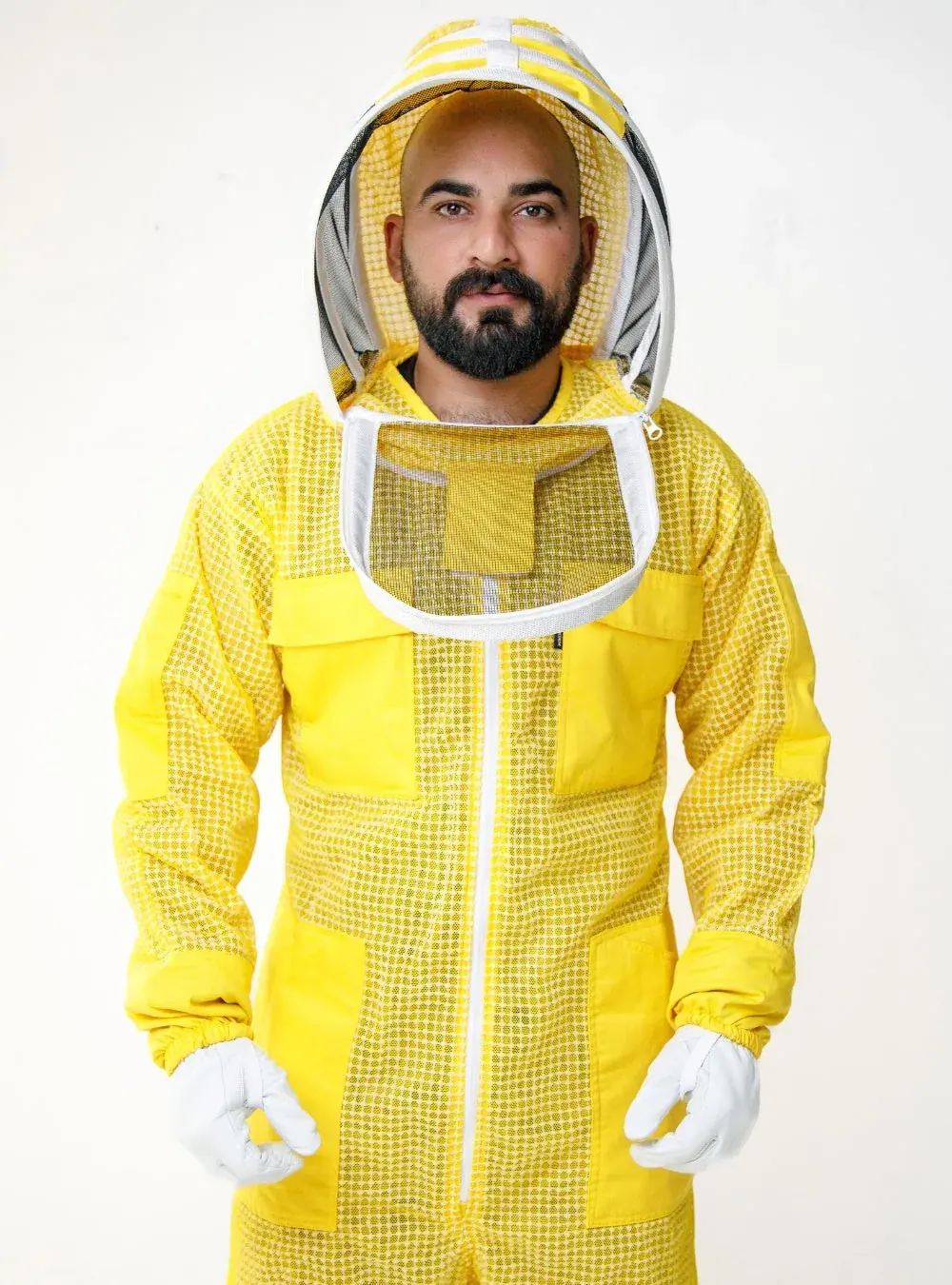
Made-to-measure removes the compromise. Our custom-fit bee suit is cut to nine measurements: chest, waist, hip, height, inseam, sleeve, neck, shoulder and preferred ease. You choose a cotton suit, a ventilated suit, a jacket or a children's suit, and a fencing, round or convertible veil. It is the simplest answer if you have tried standard sizes and never found one that passes every test.
If you are between two ready-made sizes, see our guide to choosing a bee suit between sizes: the short answer is to go up.
Suits to 5X-Large, or cut to your measurements
Almost every suit and jacket we make comes in X-Small to 5X-Large, in cotton and three-layer ventilated mesh. Or send us your nine measurements and we will cut the suit to you.
Common questions
Do bee suits come in plus sizes?
Yes. Almost all of our ready-to-ship suits and jackets run from X-Small to 5X-Large, and our custom-fit suit is cut to your own nine measurements instead of a standard size.
What size bee suit should I get if I am plus size?
Choose by your largest measurement, usually chest or belly, measured over the clothes you wear underneath. If that puts you between sizes, take the larger one. Then check leg and sleeve length, because a larger size may also be longer.
What if a plus size bee suit is too long in the legs?
On a suit with elasticated ankles, a little extra length gathers over your boots, which is fine. If the legs drag under your heels, wear the suit a few times before hemming, or choose a made-to-measure suit cut to your own inseam.
Which bee suit is coolest for a larger beekeeper?
A three-layer ventilated mesh suit. Air moves through the mesh, and the mesh's thickness holds the outer layer slightly off your skin. Texas A&M notes that cotton canvas suits can be very hot in summer.
Are there beekeeping gloves for large hands?
Yes. Our BeeGuard Spectrum five-pack of cotton goatskin gloves comes in sizes up to 5X-Large. Look for a gauntlet wide enough to pull over the suit sleeve and up the forearm without straining.
Is a bee jacket easier to fit than a full suit for plus sizes?
Often, because you only fit the upper body and wear your own trousers. Check the jacket's length: a jacket that is too short rides up at the waist when you bend, opening a gap.
Written by Alex, Bee suit maker, BEESUITWEAR · United States.
Writes about protective clothing from the workshop where the suits are made.