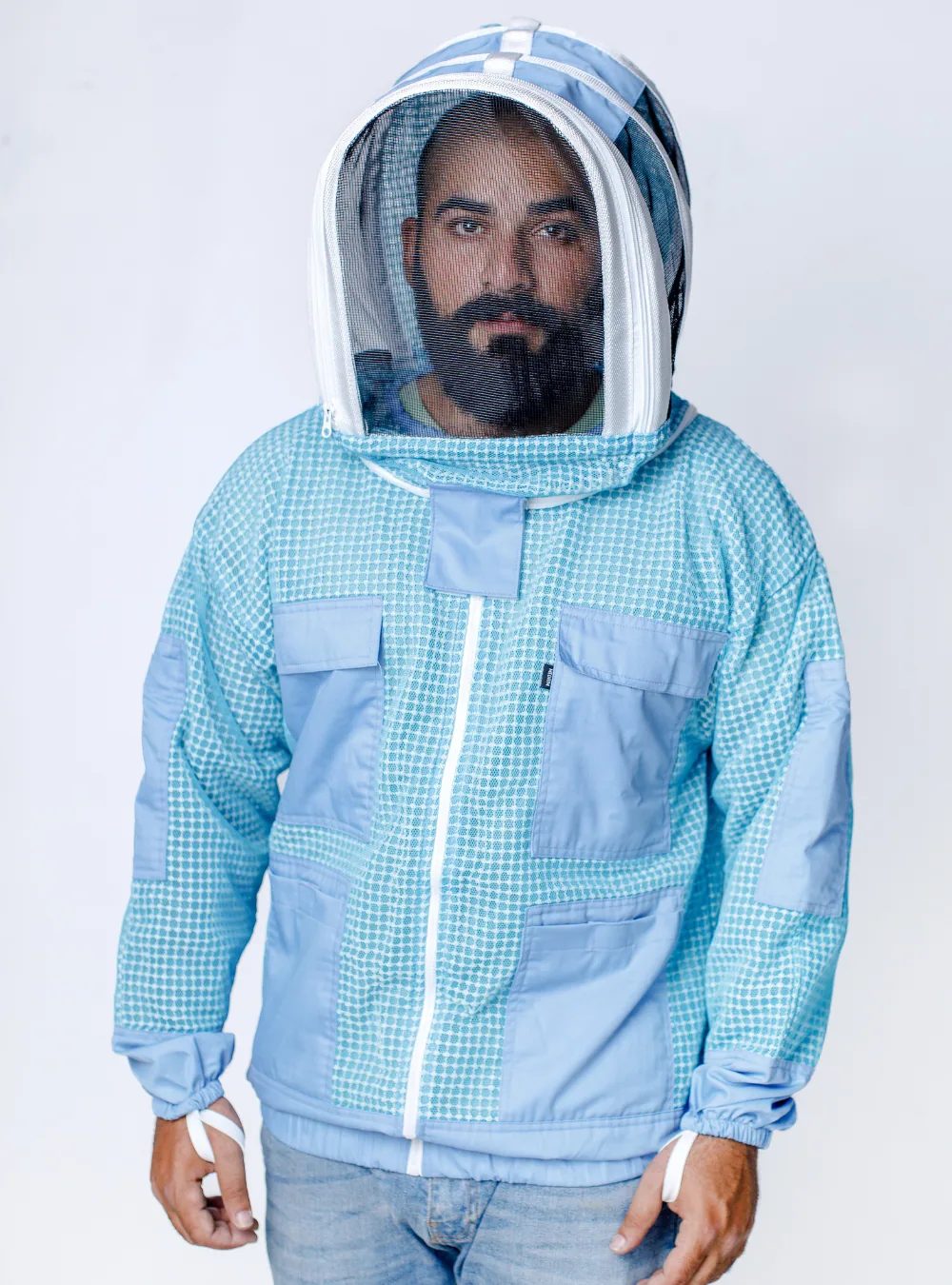
Beekeeper costume vs a real bee suit
A beekeeper costume is a pale boiler suit and a hat with netting. It looks right and protects against nothing, because every part that keeps bees out is a part the costume leaves off.

A beekeeper costume is fine for a party and useless at a hive. It copies the two things you can see from a distance: a pale coverall, and a hat with netting. It leaves out every part that keeps bees on the outside - the veil's zip to the collar, elasticated cuffs, a sealed ankle, and fabric that holds a sting away from skin.
Worth saying plainly, because people do buy one and then open a hive in it.
What a beekeeper costume gets right
The silhouette. That is not nothing, if dressing up is the whole point. Pale colour, a hood or a hat, netting over the face. From three metres away it reads as a beekeeper.
It is also cheap, light and packs small. Exactly the qualities you want in fancy dress, and exactly the qualities that make it dangerous near bees.
What a beekeeper costume leaves out
Every one of these is a gap a bee finds within a minute of being annoyed.
| Part | Costume | Real bee suit |
|---|---|---|
| Veil to body | Netting hangs loose, or a hat curtain is tucked in | Zipped to the collar both sides, so there is no opening at the neck |
| Veil shape | Rests against the face | Held 5-10 cm clear by a collar or frame, so a sting cannot reach through |
| Mesh | Decorative netting, often wide enough to walk through | Woven to a gauge a bee cannot pass |
| Cuffs | An open hem | Elastic, or elastic with a thumb loop |
| Ankles | An open hem | Elastic, and long enough to overlap a boot |
| Fabric | Thin polyester, one layer | Heavy cotton, polycotton, or layered mesh holding a gap off the skin |
| Zip | Often none, or a short decorative one | Full length, double-ended, backed by a flap |
The fabric row surprises people. A honey bee's sting is long enough to pass through a single layer of thin polyester with room to spare. Thickness is not what stops it in a good suit either. What stops a sting is distance, which is why layered mesh works at a fraction of the weight of canvas.
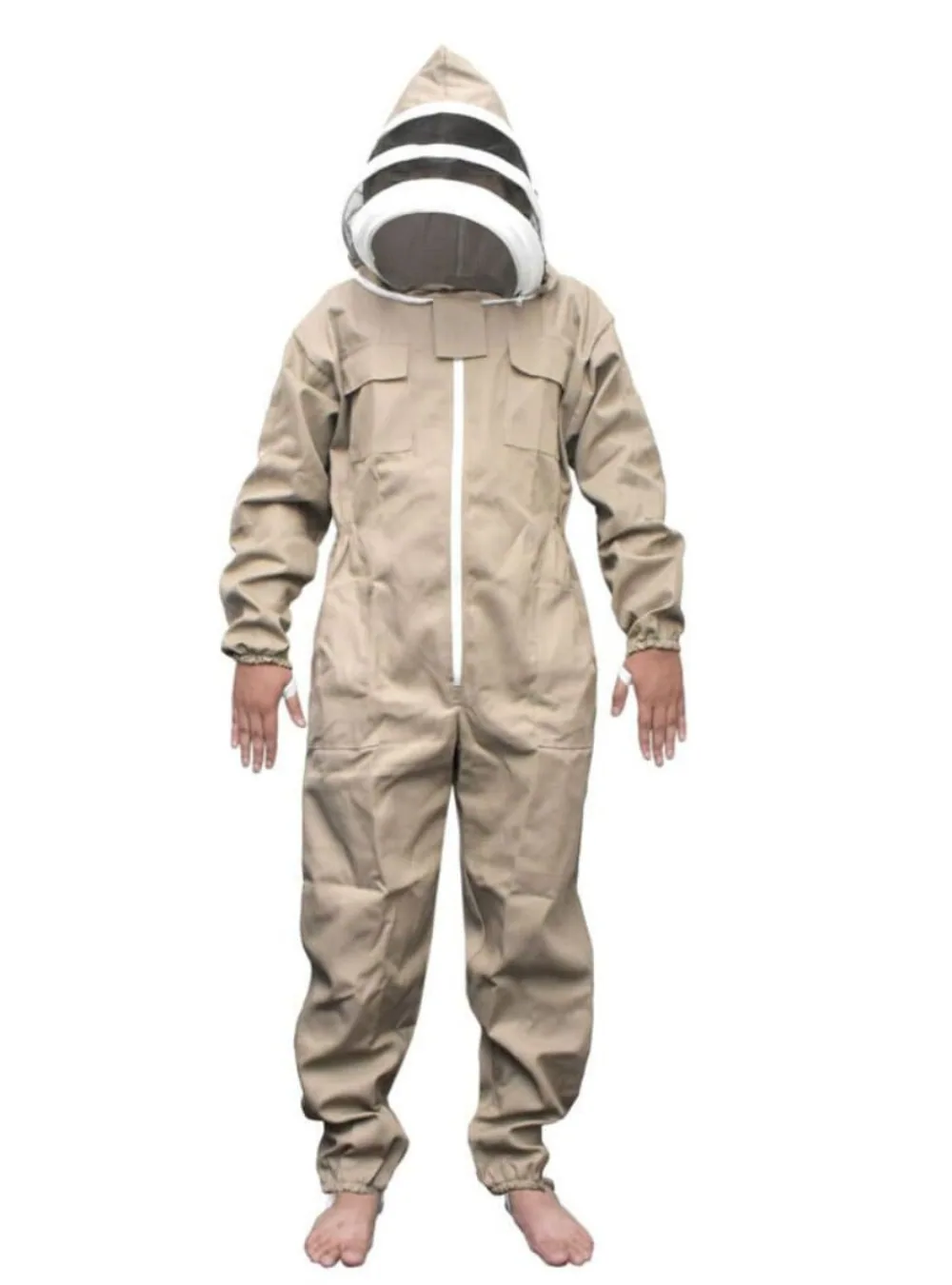
"It is just one quick look at the hive"
This is how most of the stings happen. A quick look means standing over an open colony with your face at entrance height. It happens in the one minute when the bees are most defensive, wearing netting that rests on your cheek.
If you want to watch a colony without a suit, do it properly. Two metres to the side of the entrance, ordinary pale clothing, nothing open. That is genuinely safe and costs nothing. What is not safe is the middle ground: half dressed as a beekeeper, close enough to be one.
A beekeeper costume and children
This is the version of the question that matters most, because a child in a costume looks protected to an adult glancing over.
They are not. A child's reaction to stings is also harder to predict than an adult's, so the margin you are working with is smaller rather than larger. If a child is going near a colony, they need a child's suit - what age a child can wear a bee suit and the children's buying guide both start from fit rather than from looks, and beekeeping with children safely covers the rest.
What to buy instead
If the appeal is the look, a real jacket costs less than people expect. It is also the thing the costume is imitating.
- A jacket with an attached veil covers everything above the waist, worn over your own trousers. For a photo, a school open day or a first look at a friend's hive, this is the sensible buy. How to choose a beekeeping jacket covers the veil styles, and the jacket range starts well below the price of a suit.
- A full suit if you will be handling frames. Whether a beginner needs a full suit is a real question with a real answer.
- A child's suit rather than a child's costume. The made-to-measure children's suit exists because graded child sizes fit badly at the extremes.
Using a beekeeper costume as a costume
No objection at all. It is a good costume. Two small things make it a better one.
- Wear the netting over a wide-brimmed hat rather than against your face. It sits the way a real veil sits, and it photographs better.
- Tuck the cuffs into gloves. Again, that is what a beekeeper looks like, and it takes a second.
Just keep it away from a colony. If someone at the party keeps bees and offers a look at the hive, borrow a jacket. Most beekeepers own a spare, and what beekeepers actually wear explains why they do.
The short version
A beekeeper costume is a picture of protective clothing. It has the outline and none of the function, and the parts it omits are the only parts that were doing anything.
Wear it to a party. Borrow or buy a jacket for the hive. For the real thing, the University of Georgia bee programme and Penn State Extension both publish beginner material that assumes you are handling bees rather than dressing as someone who does.