
Fencing veil pros and cons
A fencing veil gives you the best visibility and the fastest on-and-off of any veil shape. What you give up is clearance at the shoulders and at the face when you look down.

The pros and cons of a fencing veil come down to a single trade. It gives you the clearest view and the quickest on-and-off of any veil shape, and it packs flat. What you give up is clearance: it follows the shape of your head and shoulders rather than standing away from them, so when you tip your head forward the mesh comes nearer your face than a round veil's would.
How it is built
A fencing veil is a shaped collar of stiffened mesh that zips to the jacket and stands up on its own — the shape comes from the mesh itself, not from a hoop or a hat. That single fact explains every advantage and every drawback below, so it is worth holding on to.
Because there is no frame, there is nothing to seat, nothing to rotate out of position, and nothing to pack around. Because there is no frame, there is also nothing holding the mesh away from you when you lean.
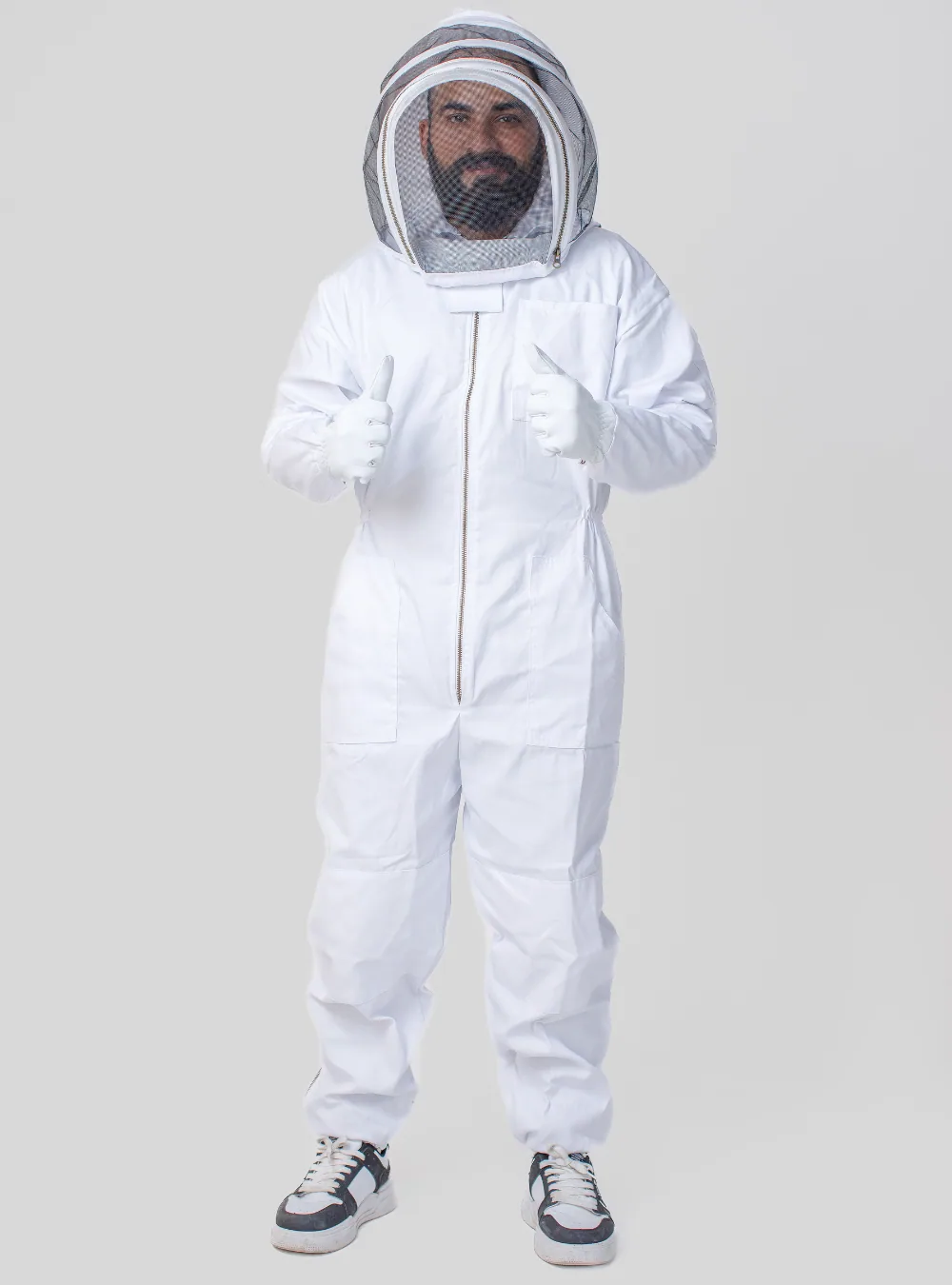
Fencing veil pros: what it does well
Visibility. The mesh sits close to your eyes with nothing in the way — no hat brim across the top of your vision and no hoop at the edges. Of the three common shapes this is the one that interferes least with seeing what you are doing, which matters when you are reading a frame or looking for a queen.
Speed. One zip and it is on. There is no hat to seat and nothing to tie off, so it is the veil you can actually get into in the thirty seconds before you open a hive. That sounds like a small thing and is not: the veil you can put on quickly is the veil you put on at all.
It stays put. Attached to the collar all the way round, it cannot shift independently of the jacket. A hat-and-veil can rotate until the gap is somewhere you did not intend; this cannot.
Storage and transport. It folds flat against the back when unzipped, so the jacket hangs on a hook like any other garment and packs into a bag without being crushed out of shape. A round veil's hoop takes up a box of its own.
Nothing to replace separately. No hat to lose, no ties to fray.
Fencing veil cons: what it does less well
Clearance at the face. Because the shape follows your head, the gap between mesh and nose is smaller to begin with and smaller again when you look down. Looking down is most of beekeeping. This is the real trade-off and it is why some beekeepers never get on with the shape.
Clearance at the shoulders. The mesh comes close to the tops of the shoulders, which is where bees land when you are standing over an open box. A round veil holds the mesh further out there, and that extra inch is the whole reason the older shape survives.
It can touch in heat. Mesh resting against a sweating forehead is unpleasant, and it is also the one condition in which a sting can reach you through it.
Glare. With the mesh close to your eyes, bright sun behind you lights up the weave rather than the hive. A round veil's distance helps slightly here.
Fencing against the alternatives
| Fencing | Round (hat and veil) | Square | |
|---|---|---|---|
| Visibility | Best | Brim cuts the top | Good, with corner distortion |
| Clearance at the face | Least | Most | Good at the front |
| Clearance at the shoulders | Least | Most | Middling |
| Speed on and off | Fastest | Slowest | Middling |
| Stays where you put it | Yes | Can rotate | Yes |
| Packs flat | Yes | No | Partly |
Fencing versus round veils takes that comparison further, and round versus square covers the other pair, which is the comparison to read if you have already ruled a fencing veil out.
Beyond the pros and cons: how a fencing veil fails
Three ways, and none of them is the mesh wearing out.
The zip. Opened and closed every visit, often with sticky gloves, and run round a curve rather than a straight line. This is what goes first on a veil that gets used.
A snag in the mesh. A centimetre of damage from a thorn, a nail or a washing machine becomes a hole within a season. Worth inspecting against the light every few visits.
The stiffening going soft. The shape is the protection. A veil that has been stuffed into a bag for two years and has lost its stand is a veil resting on your face.
All three are reasons to check whether you can replace the veil on its own — which, if it can, is worth more than any warranty length. What to check in a warranty goes through that.
Two things that make a fencing veil better
Keep your head up. Set the hive at a height where you can read a frame by lifting it rather than by bending over it. Most face contact happens because the work is too low, not because the veil is wrong — a hive stand that brings the box to waist height fixes more than a new veil would.
Wear a cap under it. A thin peaked cap pushes the mesh forward a centimetre or two and keeps it off a wet forehead. It costs nothing, it cuts glare, and it removes the veil's main complaint. If you take one thing from this page, take this one.
Glasses, and seeing through it
Long hair tied high pushes the hood forward and costs you the same clearance — women's sizing covers that and the shoulder seam. Glasses work better under a fencing veil than under most alternatives, because there is no brim and no hoop to collide with the arms. The catch is distance: with the mesh close to the lens, the weave is nearer your focal point and takes more getting used to, which is why a veil for glasses wearers is its own question.
Two practical notes. Anti-fog treatment matters more here than with a round veil, because the mesh is closer to your breath. And a dark mesh in front of the eyes is doing real work — why veil mesh is black sets out the optics. A pale mesh looks better in photographs and is harder to work behind.
Looking after it
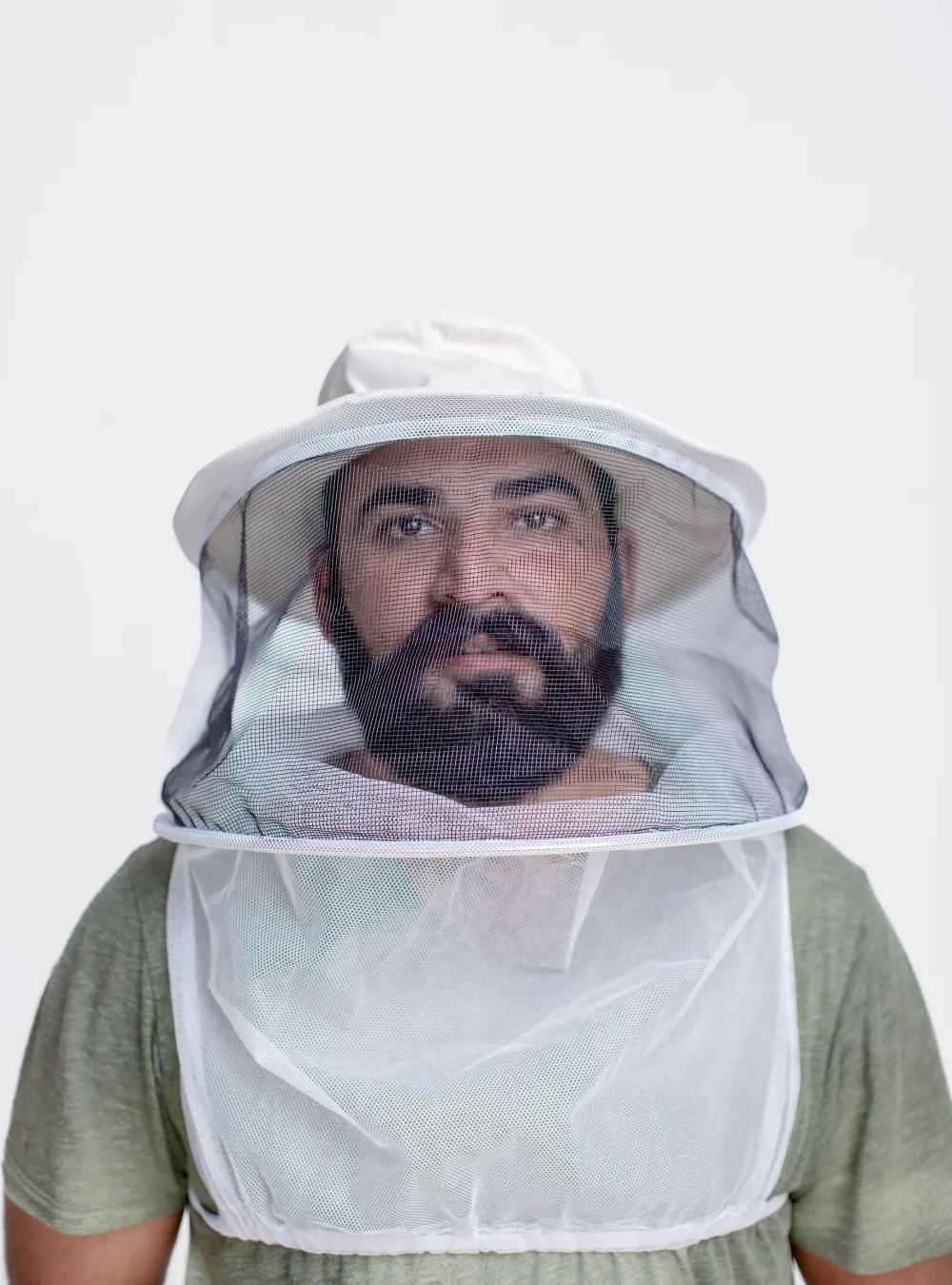
- Unzip the veil before washing the jacket, and wash it separately or not at all — washing a suit without ruining it covers the method. Mesh in a drum with a zip or a hook is how holes happen.
- Store it dry, out of the light, and indoors — a veil kept cold holds its folds, which matters for early-season inspections.
- Hang it rather than folding it into a corner, so the stiffening keeps its shape.
- Repair a snag the week you find it.
Who it suits
Buy one if you keep a few hives, you are in and out of them often, you want to see properly, and you are not standing over an aggressive colony for an hour at a time. For most hobby beekeepers in most seasons, this is the right shape — which is why it has become the default.
Look at a round veil if your colonies are defensive, you work for long stretches, you do removals, or you have been stung through a veil before. The extra standoff is not a nicety in those conditions.
Have both if you can. They are not expensive relative to a suit, and the honest answer for a lot of beekeepers is a fencing veil for inspections and a round veil for the jobs that go badly.
If you want a second opinion that is not from somebody selling veils, extension programmes cover protective kit as part of their general guidance — Penn State's beekeeping basics and the University of Georgia Bee Program are both worth reading before you commit to a shape.
Whether you need a hat depends on which shape you pick. Our hats and veils include both, the ultralight fencing veil is the lightest of them, and every beekeeping jacket takes a veil that zips off — so the fencing veil pros and cons above are a choice you can change later.