
How to choose a beekeeping jacket
The jacket is what most beekeepers actually wear. Five things decide whether yours works, and only one of them appears in a listing.

To choose a beekeeping jacket, check five things: whether the veil detaches, how far the jacket comes below your waist, whether the cuffs are elasticated, how many bonded layers it has, and whether it fits over one thin layer. Only the last appears on a size chart, and the first decides how long the jacket lasts.
Why choose a beekeeping jacket rather than a suit
It is what most beekeepers end up wearing, and often what a starter kit should have contained.
It covers the half of you that is over an open box. It is cooler, cheaper and faster to get into. Your own trousers do the rest, which also halves the laundry. And one jacket fits a wider range of bodies than one coverall does, because legs are the dimension that varies most.
A full coverall is the better choice if you kneel, work over rough ground, do removals, or are buying for a child who will sit down without noticing. Bee suit versus bee jacket is the comparison in full.
1. Choose a beekeeping jacket whose veil detaches
Ask this first. The veil is the part most likely to be damaged and the part that takes a whole garment out of service when it is.
On a jacket with a zipped collar you replace a part. On one with a stitched-in hood, a snag from a thorn ends the jacket. That single difference decides the working life more than the fabric does — replacing a bee suit veil covers it.
It also lets you change shape later: fencing, round or square, without buying a jacket.
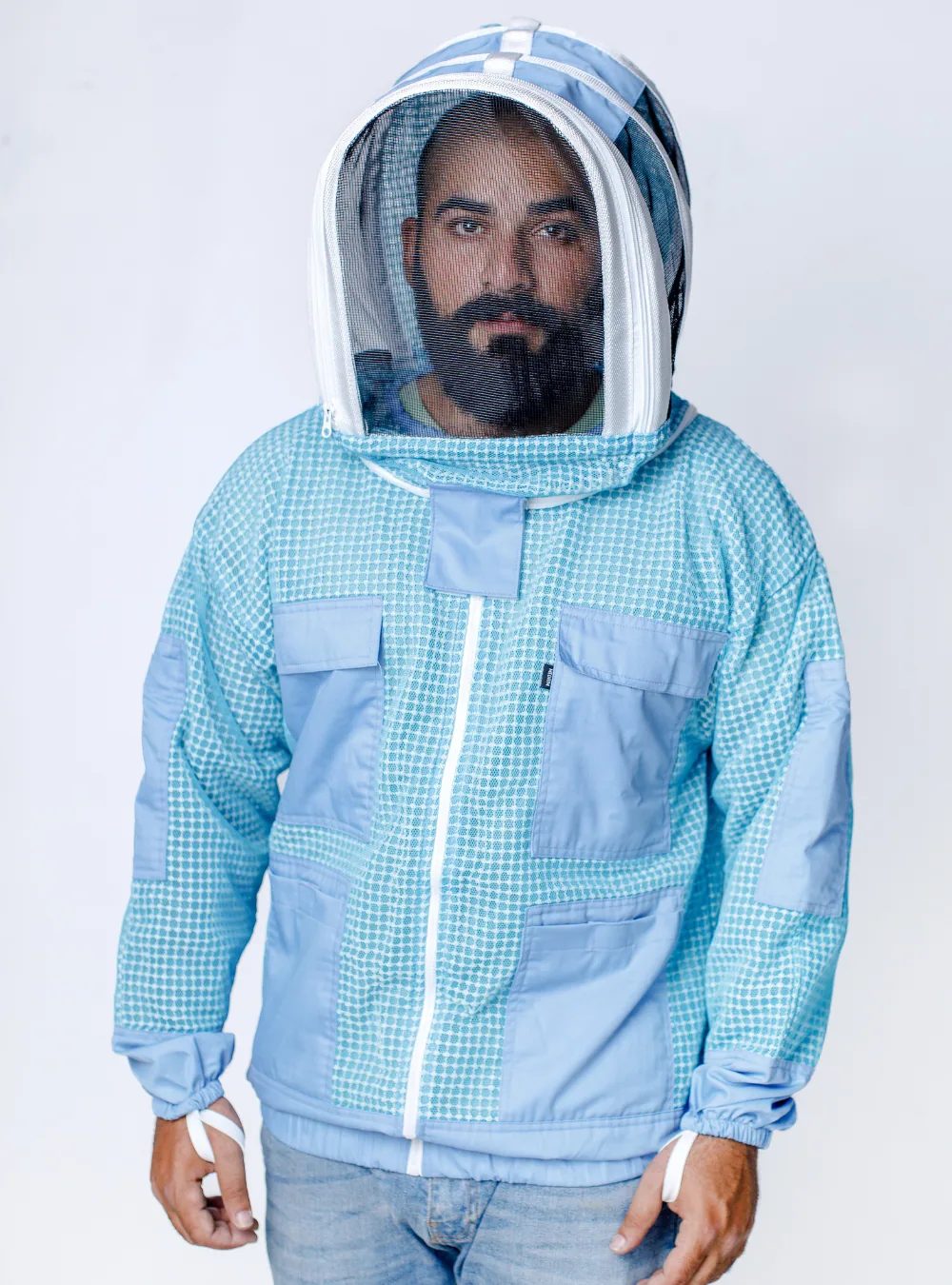
2. Choose a beekeeping jacket long enough at the waist
The one measurement nobody publishes and the one that matters most to a jacket specifically.
A jacket and trousers meet at the waist, and a join is always the weak point. When you bend forward over an open hive, the jacket rides up and the trousers stay put — so the jacket has to be long enough that the overlap survives the movement.
Test it rather than trusting a photograph: put it on, bend forward as if lifting a frame, and have somebody look at your back. A jacket that exposes skin in that position is too short whatever its size label says.
An elasticated or drawcord hem helps; a straight hem on a short jacket does not.
3. Elasticated cuffs, and ideally thumb loops
Elastic closes the wrist. A thumb loop stops the whole sleeve travelling up your forearm when you reach — and sleeve travel, not a gap, is the commonest wrist failure.
They do different jobs and the best jackets have both. Avoid adjustable cuffs on anything shared or anything a beginner will wear: there is nothing to set wrong on elastic. Elastic cuffs versus thumb loops covers the distinction.
4. Choose a beekeeping jacket on construction, not weight
Ventilated bonded mesh or woven cloth, and the choice is made by your climate rather than by a specification.
Bonded mesh holds a gap between layers, which both moves air and stops a sting under pressure. Woven cloth protects by being loose, which works and works less well when the fabric is pulled tight.
Ignore the weight figure while you are at it — GSM measures mass rather than protection, and on a ventilated jacket it tells you almost nothing.
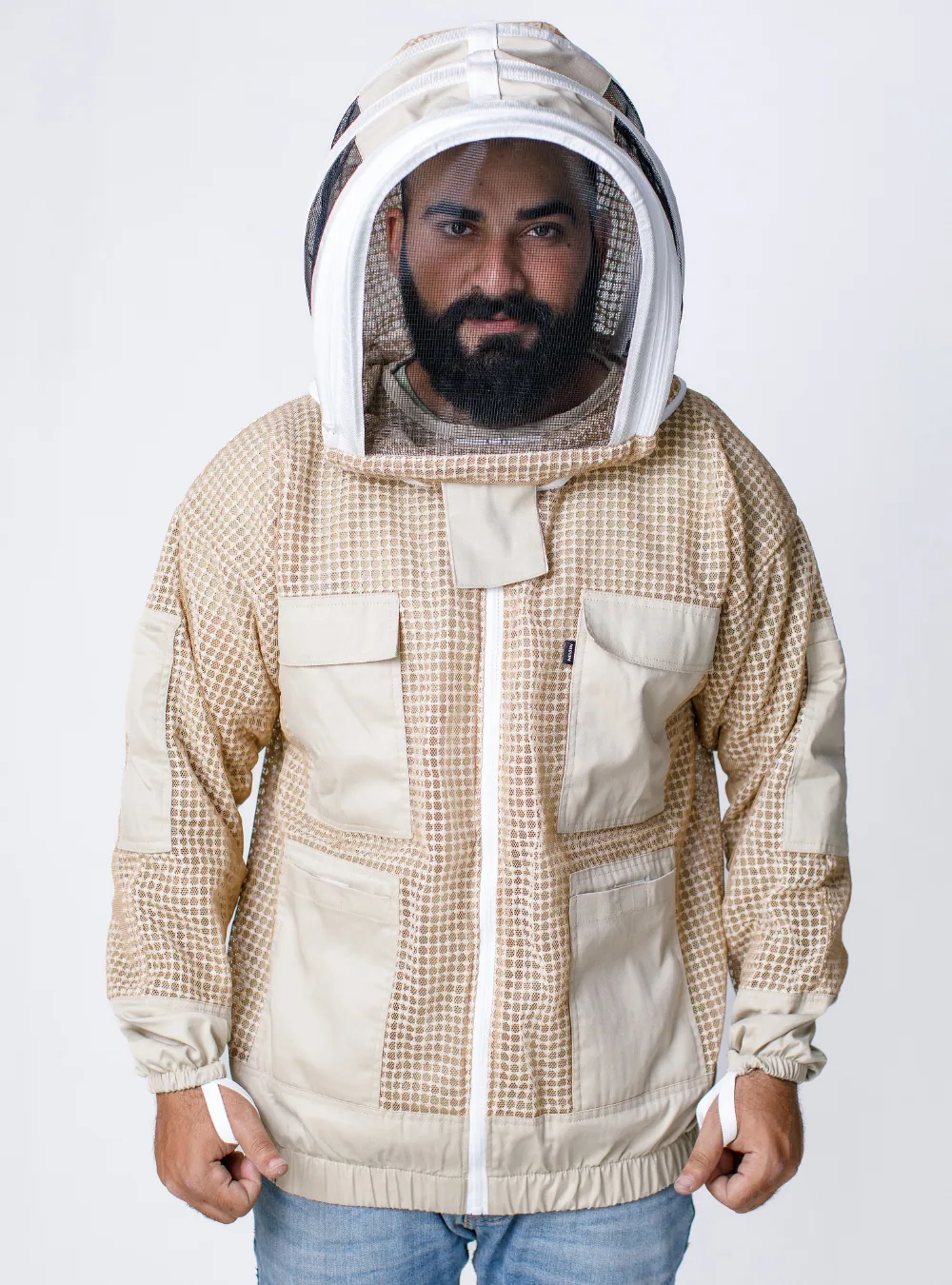
5. Choose a beekeeping jacket to fit over one layer
Buy it to close comfortably over one thin long-sleeved top, not over bare skin and not over a fleece.
Slack across the chest and back is the protection. Snug is not — fabric touching you is fabric a sting can cross. And the shoulder seam should sit on the point of your shoulder: if it has slipped down your arm, the sleeve hangs from the wrong place and the cuff loses reach, which is the fault that shows first on a narrower frame.
What to ignore when you choose a beekeeping jacket
| Selling point | Worth paying for? |
|---|---|
| Pocket count | No — a pocket is a compromise on a protective garment |
| Fabric weight in GSM | No, unless comparing two woven jackets from one maker |
| "Sting-proof" ratings | No. There is no standard test behind them |
| Long gauntlet gloves bundled in | Only if you can specify the size |
| Colour | Any pale shade. It is a preference, not a feature |
A beekeeping jacket with your own trousers
Your own trousers, for almost everyone. Loose, full-length, pale, not stretchy, and worn over the boot rather than tucked in.
Leggings and skinny jeans are the exception to avoid: both are pulled tight against the skin, and fabric touching you is fabric a sting can cross. Loose cotton work trousers are the honest answer and most people own a pair.
Purpose-made beekeeping trousers exist and are a narrower proposition than people expect — beekeeping trousers covers when they earn their place, which is mostly long hot sessions and awkward sizing.
Where a beekeeping jacket falls short
Be clear about this before choosing one.
It leaves your legs to whatever you put on, it has a join at the waist that opens when you bend if the jacket is short, and it is no use at all if you kneel on rough ground. For removal work it is the wrong garment entirely.
What it is excellent at is ordinary inspections, in warm weather, by somebody who stands up to work. That is most beekeeping, which is why most beekeepers own one.
The two-minute check when it arrives
- Put it on over the layer you will actually wear, and zip it fully.
- Reach forward. The cuffs should stay over your gloves.
- Bend forward. Nothing should show at your back.
- Look down at your boots. The mesh should keep a visible gap from your nose.
- Stretch each cuff and release. It should snap back.
Do it while the return window is open. What to do when a suit arrives covers the rest of that first half hour.
Our beekeeping jackets and ventilated jackets all take a veil that zips off. For a kit list from somewhere with nothing to sell, see Penn State's beekeeping basics and the University of Georgia Bee Program.