
Women's bee suit sizing guide
Most bee suits are drafted on a broadly unisex block and sold by chest. That is workable, but it fails in three predictable places — and knowing which three is most of the answer.

Women's bee suit sizing is complicated by one fact: most suits, ours included, are drafted on a broadly unisex block and sold by chest measurement. That works for a lot of people and fails in three predictable places on a frame with a narrower shoulder-to-hip ratio — the shoulder sits too wide, the rise is too long, and the chest size you have to buy for leaves the waist enormous.
Why there is no separate women's bee suit block
Not laziness, mostly economics. A protective garment needs slack to work, and slack forgives a lot of fit error. That makes one block across a wide size range genuinely viable in a way it would not be for a shirt — and it keeps the range affordable and in stock.
The cost is at the edges. The further your proportions sit from the block's assumptions, the more of the forgiveness you spend on fit and the less is left doing its actual job. That is the trade, and it is worth knowing which side of it you are on.
Women's bee suit sizing starts at the chest
The kit itself is the same whoever wears it; only the fit changes. Chest is still the number you order by. It decides whether the zip closes and whether there is slack where slack does the work. Take it over whatever you wear in the apiary, not over bare skin — a suit measured over a vest and worn over a fleece is a suit that does not close.
Then check these three, because they are the ones a chest measurement does not predict.
- Shoulder width. If the shoulder seam sits down your upper arm, the whole sleeve hangs from the wrong point and the cuff loses an inch of reach. This is the most common one, and the most consequential.
- Rise. Waist to crotch. Too long and the suit sags when you crouch, which drags the collar and moves the veil.
- Hip against waist. If you had to buy up two sizes to get the hips in, the waist is now loose enough to bunch under a belt or a strap.
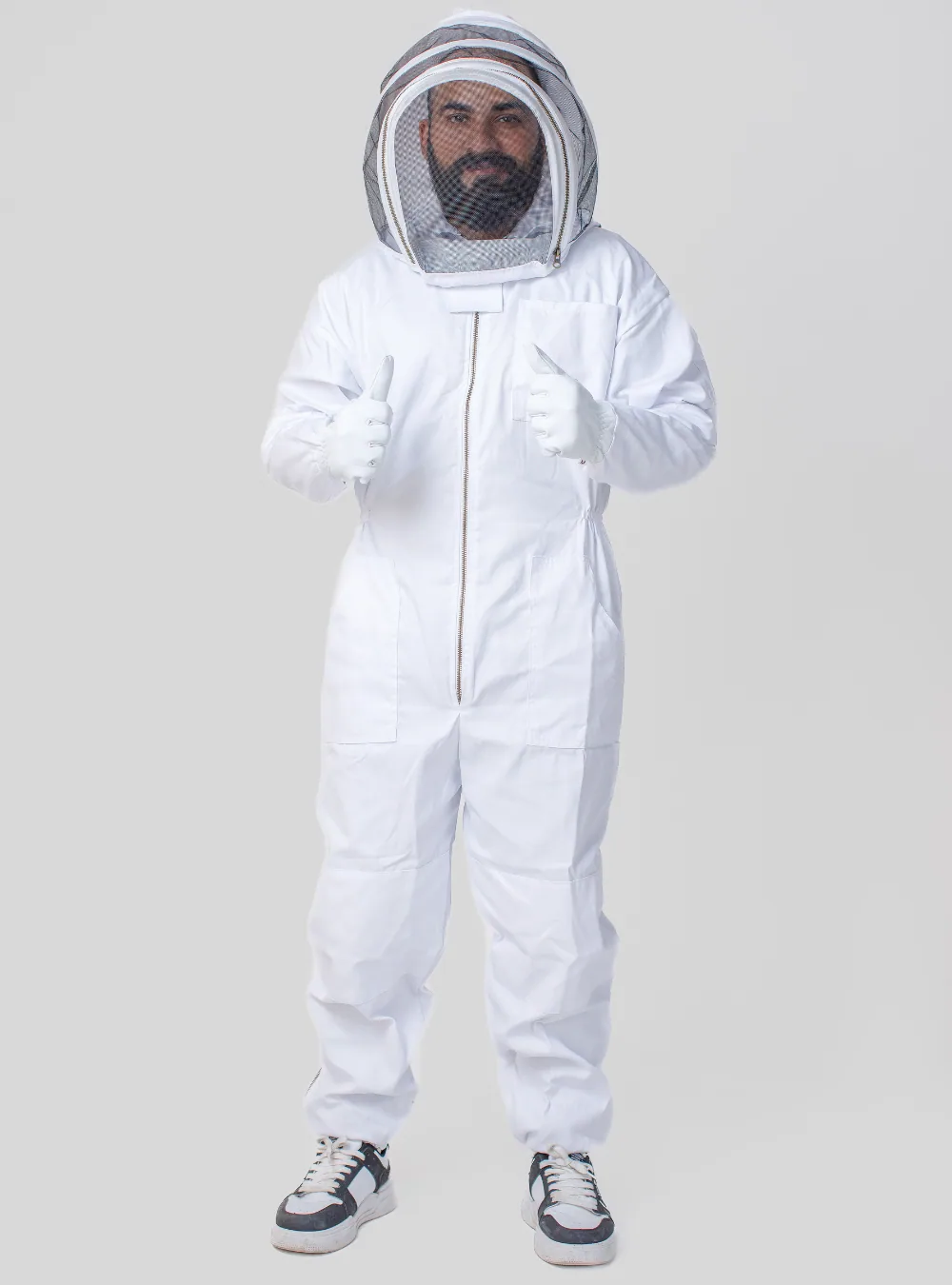
Women's bee suit sizing: up or across?
A simple rule that holds most of the time: size up for hips, never for bust.
Extra room across the chest is harmless — it is the slack that stops a sting reaching skin. Extra room across the hips is harmless too. But sizing up to fit the hips drags the shoulders and sleeves up with it, and that is the change that costs you cuff coverage.
If the gap between what fits your hips and what fits your shoulders is more than one size, a graded suit is not going to do both. That is the point at which a measured suit stops being a luxury and starts being the only thing that works. Plus-size fitting covers the same problem at the larger end of the range.
What a badly sized women's bee suit costs
Not comfort — safety, and in a specific way worth spelling out. It is also the failure no warranty will pay for, because a split seam on a suit that was too tight gets put down to fit.
A shoulder seam that has slipped down the arm shortens the effective sleeve. The cuff then sits higher than it was drawn to, and when you reach into a box the gap opens at the wrist. Every other fit problem on this page is an annoyance. That one is the mechanism by which people get stung through a suit that "fits".
The second cost is subtler. A suit that is uncomfortable is a suit you take off early, work in half-zipped, or leave in the shed on a hot day — and the suit you are not wearing protects you from nothing at all.
Women's bee suit or jacket on a narrower frame?
A jacket solves two of the three problems above, because rise and hip-against-waist both stop existing. What is left is the shoulder, which is the one that matters most — so a jacket is not a complete answer, but it is a cheaper and cooler one.
Coveralls are better if you kneel, work over rough ground, or want one garment rather than a combination that can gap at the waist. Bee suit versus bee jacket is the full comparison.
Gloves are the real gap in the market
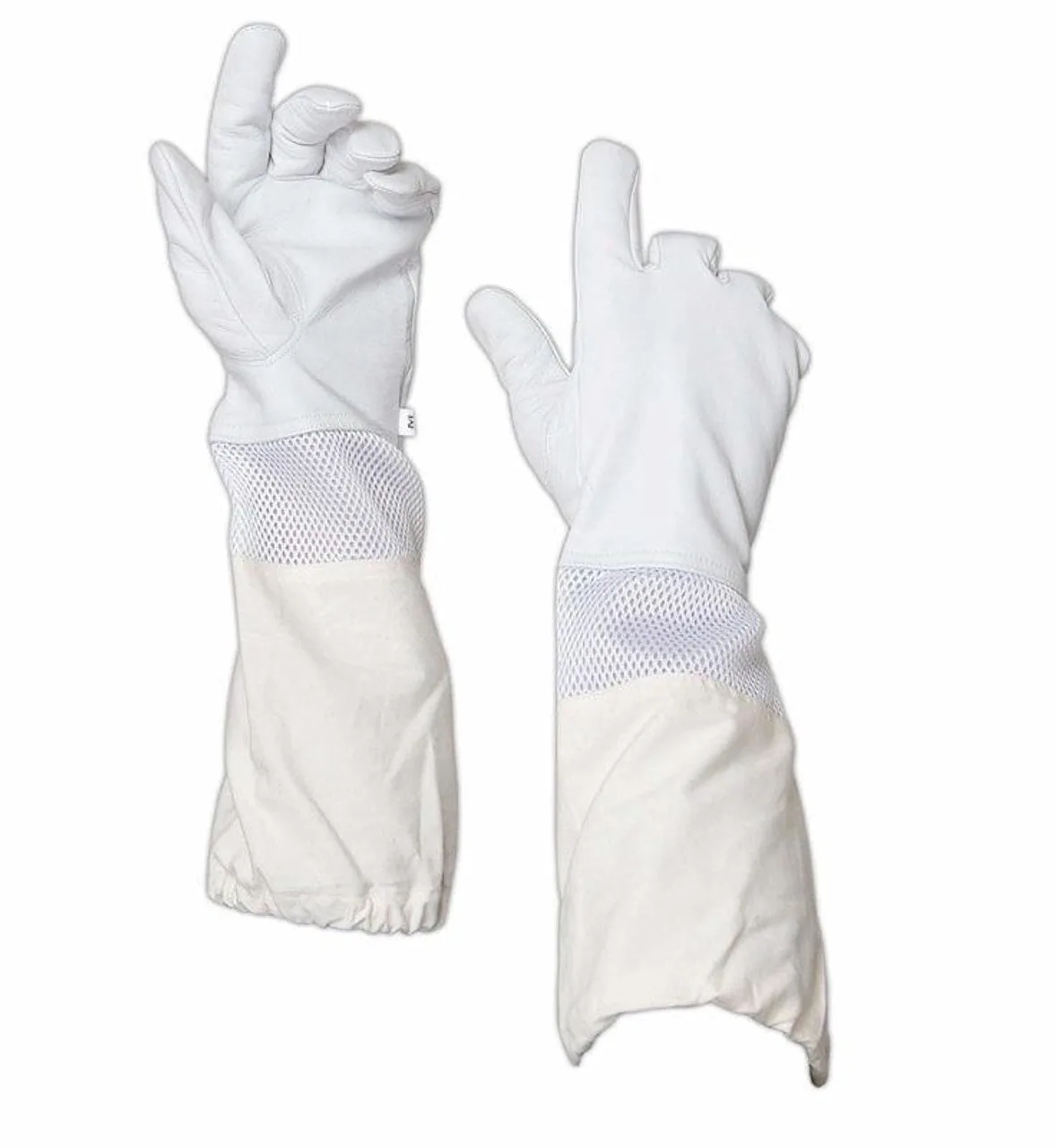
And gauntlet length is the wrong thing to shop on: buy for the hand. Suits are made in a wide range. Gloves often are not, and a glove that is too large is worse than a suit that is too large, because dexterity is the whole point of a glove. Clumsy hands crush bees, and crushed bees make a defensive colony.
Two things help. Buy for the hand rather than for the cuff length — gloves sizing explains why a short gauntlet with a good fit beats a long one that slides. And consider the thinner materials: nitrile versus leather and leather versus goatskin both come out differently when dexterity is weighted properly.
Hair, and the veil
Worth saying because nobody puts it in a size chart. Long hair tied high pushes the back of the hood forward, which reduces the standoff at the front — the gap you actually depend on. Tie it low, at the nape, and the veil keeps the clearance it was built with.
Check it the way you would check anything else about a veil: put it on, look down at your own boots, and see whether the mesh touches your face. The fencing veil in detail covers how little clearance that shape starts with. Fencing versus round veils covers how much clearance each shape gives you to start with, and a round veil is the more forgiving of the two if you work with long hair up.
A changing body, and a women's bee suit that still fits
Pregnancy, weight change and anything else that moves your measurements raise the same question, and the answer is the same: buy at the openings and let the body of the suit be generous. A suit that is roomy through the middle and correct at the cuffs, ankles and collar is doing everything a suit has to do. One that is snug through the middle has lost the gap that stops a sting, and that is true at any size.
If it stops closing comfortably, stop wearing it rather than working with it half-zipped. A jacket one size up is the cheap bridge.
Anything beyond the garment here is a question for your doctor rather than for a shop — extension programmes such as Penn State Extension's beekeeping resources and the University of Georgia Bee Program are the places to look for regional guidance on working with colonies. Neither they nor we can substitute for medical advice about stings.
Reading a chart that only lists chest
Most suit charts give you one column. Here is how to get useful information out of one anyway.
Ignore the weight figures while you are at it — GSM tells you less than it looks.
Find the garment measurement, not the body measurement. Some charts list the body they expect; others list the finished garment. The difference between the two is the slack, and the slack is the protection. If a chart does not say which it is, ask — a supplier who cannot answer is quoting numbers it has not checked.
Ask for sleeve and inseam for your size. They exist; they are simply not published. A supplier who will tell you is a supplier whose chart you can trust, and two numbers over email are cheaper than a return.
Compare against something you own. Lay a jacket that fits you flat and measure its sleeve from the shoulder seam, and its width across the chest a few centimetres below the armhole. Doubling that width gives you a chest measurement to compare with. This is more reliable than measuring yourself, because it is measuring a garment that already works.
Women's bee suit sizing: the checks, in order
- Zip it up over your apiary clothes. It should close without pulling anywhere.
- Find the shoulder seam. It should sit on the point of your shoulder, not below it.
- Reach forward. The cuffs should stay over your gloves.
- Crouch. The ankles should stay over your boots and the crotch should not pull.
- Look down at your boots. The veil should keep a visible gap from your face.
Four of those five are in how a bee suit should fit, which applies to everyone. The shoulder-seam check is the one worth adding here, because it is the one that fails first on a narrower frame and the one nobody thinks to look for.
The size guide lists the measurements we take and the sizes we cut. If two of them land in different sizes, women's bee suit sizing has run out of answers and the custom-fit suit varies them independently.